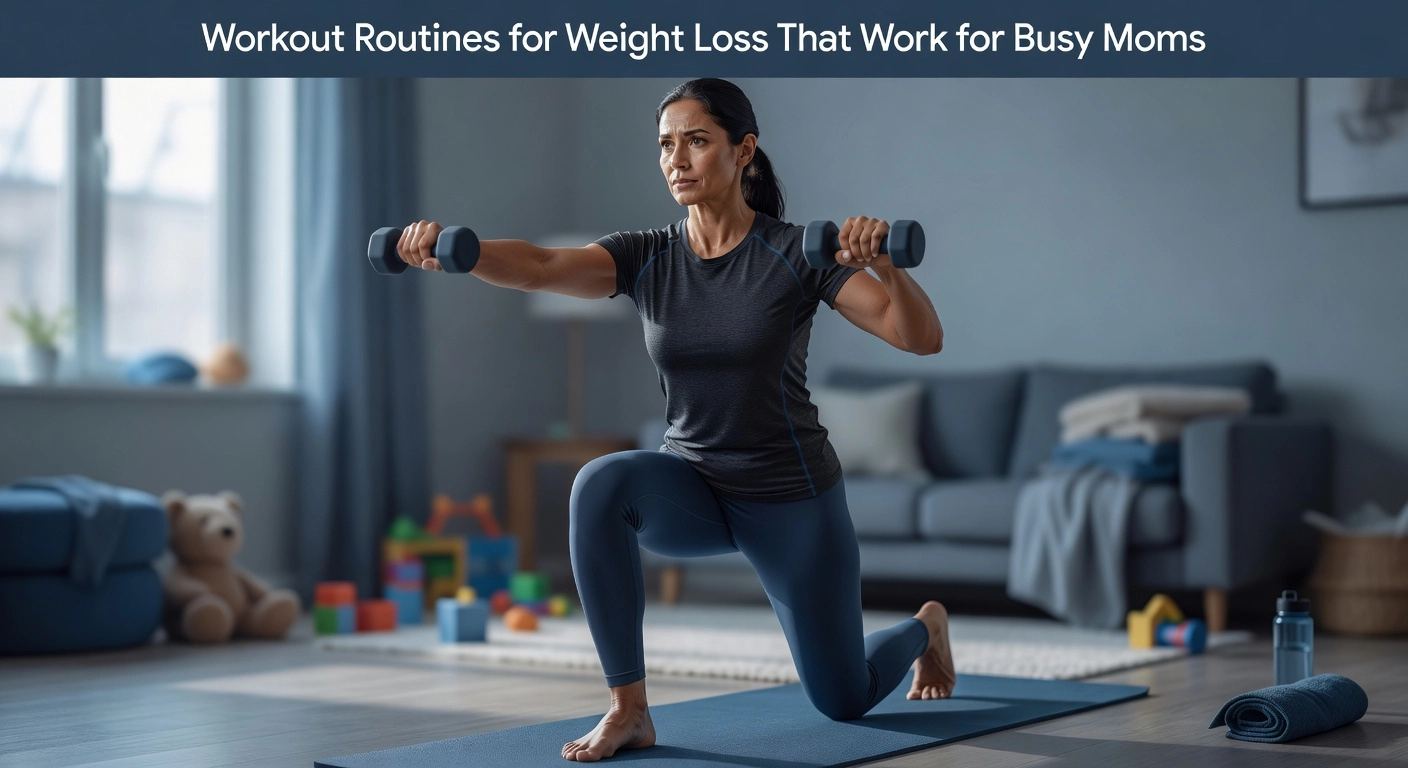
Finding realistic workout routines for weight loss for female beginners can actually feel completely impossible when you are already juggling school pickups, packing lunches, and somehow trying to keep the house from looking like a tornado hit it. If that sounds familiar, you are definitely not alone. The constant mental load of managing a household can leave you with zero energy at the end of the day, making the idea of a grueling fitness plan feel like just another stressful chore on your to-do list.
The good news is that you do not need hours at the gym or an expensive personal trainer to start seeing real results. The right approach to movement can actually be simple, short, and completely doable around a busy mom’s schedule. Yes, even yours.
In this post, we are rounding up some of the most effective and realistic routines designed specifically with your daily reality in mind. No complicated equipment, no confusing fitness jargon, and no workouts that demand two hours of your day. Just straightforward, beginner-friendly movement that fits right into the pockets of time you actually have.
Whether you have 10 minutes before the kids wake up or a quick break during the afternoon quiet hours, there is a routine here that will work for you. Get ready to feel stronger, more energized, and more confident—one manageable workout at a time!

Table of Contents
Why Most Workout Advice Is Useless If You Have PCOS (And the Best Workout Routines for Weight Loss for Female Beginners)
Okay, real talk. If you’ve ever followed a punishing workout plan to the letter, ate your sad little calorie deficit, and still watched the scale laugh at you, you are not broken. The advice was broken. For women with PCOS, the classic “work harder, eat less” approach doesn’t just fail; it can actively make things worse, and almost nobody explains why.
Here’s the short version: PCOS affects an estimated 10-13% of reproductive-aged women, and around 70% of those women deal with insulin resistance. That means your body is already struggling to process glucose efficiently, so it compensates by pumping out more insulin, which signals your body to store fat, especially around your midsection. Layer a strict calorie deficit on top of that, and your metabolism can slow down even further. Your hormones are basically playing a completely different game than the fitness influencer telling you to “just stay consistent.”
Then there’s cortisol, your stress hormone, and PCOS loves to mess with that too. Women with PCOS tend to have a heightened sensitivity to cortisol, which means high-intensity overtraining sessions don’t just tire you out; they can spike cortisol, increase inflammation, worsen belly fat retention, and throw your already-disrupted hormones into further chaos. Doing back-to-back HIIT classes is not a flex when your body is treating every intense workout like a five-alarm emergency.
The good news? A 2024 network meta-analysis published in BMC Women’s Health found that moderate-intensity aerobic exercise outperformed other exercise types for reducing BMI in women with PCOS, including yoga and high-intensity options. Brisk walks. Steady cycling. Nothing that requires you to be peeled off the floor afterward. Science is finally catching up to what exhausted PCOS moms have been quietly suspecting for years.
So this is your official judgment-free zone. We are done with punishing routines designed for people without hormonal chaos and three kids asking for snacks every four minutes. Everything here is built around what actually works for your body, not somebody else’s.
Walking: The Underrated Workout You’re Already Almost Doing
Let’s get one thing straight: walking is not what you do because you “can’t handle a real workout.” Walking is a real workout, and the research will back me up on that while you sip your lukewarm coffee in peace.
A 2017 randomized controlled trial found that people who added moderate walking to a calorie deficit lost significantly more fat mass than those who dieted alone, with better insulin improvements too. And a 2024 network meta-analysis confirmed that moderate-intensity aerobic exercise (hello, brisk walking) produced the greatest BMI reduction in women with PCOS compared to other exercise types, including yoga and higher-intensity options. Not second place. First. So if anyone gives you grief for “just walking,” you can cite peer-reviewed research at them.
Here is why this matters specifically for your PCOS body: walking keeps cortisol low. High-intensity workouts can spike cortisol, which is already a problem when you have PCOS and your hormones are basically running a chaotic group chat with no admin. Walking supports insulin sensitivity and encourages fat burning without triggering that stress response. It is the rare workout that actually works with your hormones instead of against them.
The WHO recommends 150 to 300 minutes of moderate activity per week, which sounds like a lot until you break it into 20 to 30 minute daily chunks. Suddenly it’s just one school pickup loop, or pacing your kitchen during a phone call.
Lazy mom ways to actually hit that target:
- Stroller walks during park trips or errands
- Parking lot laps while waiting for school pickup
- Pacing during phone calls (you’re walking already, you just didn’t know it counted)
- Sideline walking while kids are at practice instead of doom-scrolling
Consistency here genuinely beats intensity. Healthline notes that brisk walking can burn around 150 extra calories per 30 minutes, and over weeks, that compounds quietly in the background while you do literally nothing dramatic.
Bodyweight Strength Circuits: No Gym, No Excuses, No Pants Required
Here’s the thing about strength training: your PCOS actually needs it, not just wants it. When you have PCOS, your cells are often resistant to insulin, which means your body keeps pumping out more of it, and excess insulin loves to store fat (especially around your middle) and crank up androgen levels. Strength training works like a reset button for this. Muscle tissue acts as a metabolic sponge, soaking up glucose from your bloodstream and improving how your body responds to insulin. It also preserves muscle when you’re eating in a calorie deficit, so your body burns fat instead of cannibalizing the muscle you actually need. More muscle means a higher resting metabolism, which means you’re burning more calories while doing absolutely nothing. That’s the lazy girl dream and it’s backed by science.
Your Nap Time Circuit (15-20 Minutes, Pajamas Welcome)
No gym, no equipment, no judgment. Do 2-3 rounds of this:
- Squats (12 reps): Feet shoulder-width, lower like you’re sitting into a chair, back straight
- Glute Bridges (15 reps): On your back, knees bent, lift those hips and squeeze
- Push-Ups (8-10 reps): Knees on the floor is completely valid, nobody is watching
- Lunges (10 per leg): Step forward, lower down, push back up, try not to fall
Rest 30-60 seconds between exercises. That’s it. Research confirms bodyweight movements like these build real strength and improve insulin sensitivity, especially for beginners.
More Is Not Better, Especially With PCOS
Two to three sessions per week is genuinely enough to see results. PCOS fatigue is real, cortisol is real, and overtraining will stall your progress faster than a toddler meltdown derails a grocery trip. Non-consecutive days work best so your body can actually recover and rebuild. Consistency over time beats intensity every single week.
No, You Will Not Accidentally Get Jacked
Women have roughly 15 to 20 times less testosterone than men. You are not going to do 12 bodyweight squats and wake up looking like someone who has a gym sponsor. What you will get is a firmer, stronger body and a metabolism that actually cooperates. Bodyweight training builds tone and definition, full stop.
Eat Protein After You Train
After your circuit, eat something with at least 20-30 grams of protein within an hour. Greek yogurt, cottage cheese, eggs, a protein shake, whatever works. This supports muscle recovery, stabilizes your blood sugar, and stops the post-workout hunger spiral that has you eating crackers directly from the box over the sink. Pairing strength training with [consistent high-protein meals](https://journals.plos.org/plosone/article?id=10.1371%2Fjournal.pone.0138793) is one of the most effective combinations for managing PCOS symptoms and controlling cravings long-term.
Micro-Workouts: When You Only Have 10 Minutes and a Tantruming Toddler
Let’s talk about exercise snacking, which is exactly what it sounds like and also nothing like actual snacking (unfortunately). The idea is simple: instead of one long workout you’ll never do, you spread two or three 10 to 15 minute movement bursts throughout your day. They accumulate real fitness benefits, improve your blood sugar control, boost your mood, and count toward your weekly activity goals. No gym bag. No childcare. No motivation required beyond surviving until nap time.
And before you dismiss this as “giving up on real exercise,” 2026 fitness trend reports explicitly validate micro-workouts as a legitimate, science-backed format. Studies show adherence rates of 80 to 90 percent, which is basically unheard of in fitness research. It outperforms the all-or-nothing gym model for consistency, and consistency is the only thing that actually moves the needle.
Here are three micro-workouts you can steal right now:
- 10-Minute Morning Bodyweight Blast: Squats, knee push-ups, lunges, and jumping jacks. Two rounds. Done before the toddler fully processes that you’re awake.
- Lunch Break Walk: Ten brisk minutes outside or around your house. Aids digestion, clears your head, counts as cardio.
- 12-Minute Evening Stretch and Core Routine: Cat-cow, planks, glute bridges, and a little quiet. Your nervous system will actually thank you.
For PCOS fatigue specifically, this format is a game changer. Longer intense sessions spike cortisol, which tanks your energy and tells your body to hold onto fat like a hoarder. Shorter bursts deliver the metabolic benefits without the crash. And three 10-minute sessions equal 30 minutes of movement. Your body accumulates the benefits either way; it genuinely does not check your gym app for verification.
Low-Impact HIIT: All the Burn, Half the Cortisol Drama
So you’ve built your walking habit and maybe dabbled in some bodyweight circuits. Now let’s talk about turning up the heat without completely torching your hormones in the process.
Low-impact HIIT (sometimes called HILIT) is exactly what it sounds like: you get your heart rate up like you mean it, but nobody’s jumping, nobody’s landing hard, and your knees are still speaking to you afterward. Think marching with purpose instead of jump squats, or slow controlled mountain climbers instead of the kind that send your cortisol straight into orbit. One foot stays grounded at all times, but the effort is very much real.
Here’s why this matters specifically for PCOS. Standard high-intensity HIIT can spike cortisol, and cortisol is basically the hormone that tells your body to store fat, mess with your insulin, and generally make your PCOS symptoms worse. It’s a cruel little cycle. The low-impact version lets you get the metabolic benefits without triggering the stress response that works against you.
Your 15-Minute Low-Impact HIIT Template
Try this structure twice a week:
- Warm-up (2 min): March in place with arm swings
- 40 sec work / 20 sec rest, repeat 3 rounds:
- High-knee marching
- Lateral side steps with arm raises
- Slow stepping mountain climbers
- Modified squat pulses
The reason this is worth adding to your routine is EPOC, the “afterburn” effect where your body keeps burning calories after the workout ends. Walking is wonderful, but it doesn’t create that same metabolic disruption. HIIT and strength training both trigger EPOC in a way that steady-state cardio simply doesn’t.
Cap these sessions at twice a week max. If you notice increased cravings, terrible sleep, or your mood crashing like a toddler who missed nap time, that’s your body asking you to dial it back. Listen to it.
Lower Body Lifting: Your Hormones Will Actually Thank You
If you’ve got a pair of dumbbells gathering dust in the corner, a resistance band shoved in a drawer, or literally just a backpack you can fill with books, congratulations. You have everything you need to start one of the most hormone-friendly workout styles available to you. Weighted lower body work isn’t about getting a gym-worthy booty for Instagram. It’s about telling your PCOS to kindly take a seat.
The four movements you actually need to know:
- Goblet squats: Hold a dumbbell at your chest and squat. That’s it. Quads, glutes, core, done.
- Romanian deadlifts (RDLs): Hinge at the hips, lower the weights down your legs, squeeze your glutes to stand back up. Your hamstrings will have feelings about this.
- Hip thrusts: Sit against your couch, a dumbbell or band across your hips, thrust upward. The glutes are the largest muscle in your body, and they deserve attention.
- Reverse lunges: Step back instead of forward. Easier on the knees, still brutally effective.
Here’s why these matter specifically for PCOS: your lower body contains your biggest muscle groups. When you work them, your body burns more calories during the session and keeps burning after you stop. More muscle also means better insulin sensitivity, which is the actual root problem for most of us with PCOS. Better insulin response means less of that compensatory insulin flooding your system, which means your body is less inclined to store fat and spike androgens. Your hormones genuinely benefit from this.
The 2025-2026 fitness trend shift toward strength training for longevity isn’t just gym bro culture finally evolving. It’s backed by research showing that preserving muscle protects your metabolism long-term, which matters extra when PCOS is already working against you.
Your beginner starting point: 2 sets of 10 reps, 2 days per week. Monday and Thursday, fifteen minutes, light weights. Showing up twice a week consistently for two months will do more for your body composition than going heavy once and being too sore to move for a week. Boring truth, but there it is.
Yoga and Pilates: Not Just for People Who Eat Quinoa Unironically
Look, nobody is saying yoga is going to melt off thirty pounds while you hold downward dog. But if you have PCOS and you’re skipping it entirely because it feels too “wellness influencer who owns a lot of linen,” you’re leaving some genuinely useful tools on the table.
Here’s the hormonal case. Chronic stress cranks up your cortisol, and high cortisol with PCOS is basically a disaster combo. It worsens insulin resistance, promotes belly fat storage, disrupts ovulation, and tanks your sleep. Yoga and Pilates activate your parasympathetic nervous system, which is the “calm down, nobody is chasing you” response your body desperately needs. Lower cortisol means better insulin sensitivity, better sleep, and less of your body actively working against your weight loss efforts.
And the benefits go beyond the scale. These practices have been linked to improved mood, reduced anxiety (extremely common with PCOS), better cycle regularity, and more consistent energy levels. When you sleep better because you did ten minutes of bedtime yoga, you eat better the next day. That’s the actual chain reaction.
The best part is you don’t need a studio or a $40-a-month app. Search YouTube for “bedtime yoga for PCOS,” “20 minute beginner Pilates,” or “postpartum Pilates core” and you will find more free content than you could ever use. Yoga with Adriene alone could keep you busy for months.
Is this your primary fat loss tool? No. Strength training and cardio win that fight. But yoga and Pilates belong in the rotation specifically on your most exhausted, most stressed, most “I cannot do a jumping jack today” days. Choosing gentle movement over nothing is not weakness. In 2026, recovery-first fitness is the actual strategy, and you’re just ahead of the trend.
A Realistic Lazy Week Workout Schedule That You Might Actually Do
Okay, here’s the part where we actually put it all together without making your eye twitch.
Your sample week looks like this:
- Monday: Bodyweight circuit (20-30 minutes, or 10 if that’s what you’ve got)
- Tuesday: Walk (30 minutes, stroller optional, podcast mandatory)
- Wednesday: Micro-workout (5-15 minutes, floor-based, pajamas acceptable)
- Thursday: Rest or gentle yoga (full permission to do nothing heroic)
- Friday: Low-impact HIIT (15-25 minutes, no jumping required)
- Saturday/Sunday: Walk, active family chaos, or complete rest. Pick one.
That’s 4-5 active days with built-in breathing room. Research actually supports this structure, targeting roughly 150-300 minutes of moderate movement per week for hormonal and metabolic benefits.
Now here’s the part that matters more than the schedule itself: this is a template, not a court order. Swap Tuesday and Friday. Do a 5-minute version on a bad day. Skip Thursday’s yoga entirely. It still counts. You still count.
The PCOS community has a particular love affair with all-or-nothing thinking, and honestly, it makes sense given how often our bodies feel unpredictable and frustrating. But one missed workout does not erase your progress. Your body doesn’t work like an Etch A Sketch. Tomorrow is always available.
What actually moves the needle is boring, unsexy consistency over 8-12 weeks. Studies show that even a 5% reduction in body weight can meaningfully improve insulin resistance, hormone levels, and menstrual regularity for women with PCOS. That’s not a dramatic transformation montage. That’s just showing up repeatedly, imperfectly, over time. You can absolutely do that.
The PCOS Reality Check Nobody Else Will Give You
Here is the reality nobody in the fitness industry is rushing to put on their grid: weight loss with PCOS is genuinely, physiologically slower than it is for people without it. Insulin resistance, elevated androgens, and chronic low-grade inflammation all work together like a very unhelpful team to make fat storage easier and fat loss harder. This is not a mindset problem. It is not laziness. It is biology, and the sooner you stop blaming yourself for a broken system, the sooner you can actually work with your body instead of against it.
Here is the stat worth tattooing somewhere: losing just 5% of your body weight can meaningfully improve insulin sensitivity, lower testosterone levels, kickstart more regular ovulation, and reduce your risk of type 2 diabetes. Five percent. Not a dramatic transformation. Not before-and-after content. Just quiet, boring, consistent progress that your hormones will quietly thank you for.
And the scale? Genuinely not the whole story. Better sleep, fewer cravings, a mood that does not nosedive every afternoon, a cycle that shows up when expected instead of pulling a disappearing act, clearer skin, more energy to survive toddler hour without weeping. These are wins. Real, meaningful, hormone-related wins.
Now, about those social media transformation posts flooding your feed: roughly 1.4% of PCOS content online comes from actual registered dietitians. The rest is vibes, supplements, and unrealistic timelines that were never designed for a PCOS body. That cycle of motivation, restriction, burnout, and self-blame you keep riding? It is not a character flaw. It is a predictable response to bad information.
Sustainable and boring beats intense and abandoned every single time. Lazy is a strategy.
What to Eat After Your Workout So You Don’t Undo Everything
Here’s the honest truth: you can do all the right workouts and still feel like garbage at 3pm, raiding the pantry for anything that isn’t nailed down. For women with PCOS, that afternoon crash usually isn’t a willpower problem. It’s a blood sugar problem, and what you eat after your workout has a lot to do with it.
When you exercise, your muscles are primed to absorb protein and start repairing. If you skip that window, your blood sugar can swing, cortisol creeps up, and suddenly you’re “not even that hungry” until you’ve eaten half a bag of crackers standing over the sink. Protein after your workout blunts those spikes, supports muscle repair, and keeps the craving chaos quieter for the rest of the day.
The principle is simple: aim for 20 to 30 grams of protein within an hour or two after working out. That’s it. No food scale required.
Easy, lazy options that actually get you there:
- Greek yogurt with chia or pumpkin seeds (roughly 15 to 20 grams, blood sugar friendly)
- A protein shake mixed with water or milk (hits 20 to 30 grams with zero cooking)
- Cottage cheese plain or with a little fruit (around 20 to 25 grams per cup)
- Three or four eggs any way you can manage them
Pairing regular exercise with protein-forward eating is genuinely one of the most evidence-backed strategies for PCOS body composition, not just weight loss, but actual changes in how your body stores fat and manages insulin. The scale might move slowly, but your hormones are paying attention.
For more ideas that fit real mom life, check out the high-protein recipes and the full PCOS weight loss guide for busy moms on lazyfitmom.com. That’s where the workout and the eating actually come together into something sustainable.
Start Small, Stay Lazy, Actually See Results
Here’s the truth you’ve been waiting for at the bottom of a very long list: there is no perfect workout plan for PCOS moms. There is only the workout you will actually do, in the time you actually have, with the energy you actually possess on a Tuesday night. That’s it. That’s the whole secret the fitness industry doesn’t want to sell you because it’s free.
Walking most days, plus two short strength sessions per week, is genuinely and scientifically enough to start moving the needle on insulin resistance, hormones, and body composition. You don’t need to earn a more complicated plan. More comes later, naturally, when your body asks for it instead of collapsing at the suggestion.
Pick one routine from this list. Not three. Not a fresh 12-week program you found at midnight. One thing, once this week. Repeat it next week. That’s momentum.
PCOS weight loss is a long game, and small, consistent habits will always beat the intense bursts you can only sustain for nine days before giving up and crying into a protein shake. The body keeps score slowly and rewards patience.
And honestly? The workout that counts is the one you did in your pajamas at 9 pm because it was the only window you had. That one counts the most.
Conclusion
You do not need a perfect schedule, a gym membership, or hours of free time to start transforming your health. The most important takeaways from this post are simple: short workouts absolutely count, consistency beats intensity every time, and the best routine is the one you will actually stick with. Even 10 minutes of intentional movement can add up to real, lasting results over time.
Now it is your turn to take action. Pick one workout from this post and commit to trying it this week. Just one. Start small, be patient with yourself, and remember that every single rep is an investment in the strongest, healthiest version of you.
You show up for everyone else every single day. It is time to show up for yourself, too. Your journey starts now, and you are more capable than you know.
⚡ Simplify Your Daily Mom Fitness Routine
Staying active shouldn’t feel like another stressful obligation on your calendar. Balance your physical strength, metabolism, and daily energy with these realistic, mom-tested guides and low-effort shortcuts:
📚 More Practical Fitness & Recovery Guides
- General Routine Upgrades: Looking for broader lifestyle tips? Check out our favorite realistic Workout Routines for Busy Moms.
- Postpartum Entry Point: Ready for a complete, structured timeline built for early recovery? Check out our Postpartum Workout Plan for Beginners.
- Gentle Low-Impact Movement: Rebuild your stamina and lower cortisol levels naturally with Walking for PCOS and Postpartum Health.
- Safe Ab Rehabilitation: Protect your core and learn how to manage muscle separation with Safe Exercises for Diastasis Recti: A Realistic Guide.
- The Low-Effort Core Shortcuts: Tight on time? Try these gentle movements you can do from the floor or bed: Lazy Girl Exercises for Diastasis Recti.
🛠️ Grab Your At-Home Routine Shortcuts & Checklists
Take the planning, guesswork, and mental fatigue completely out of your health journey with these ready-to-use digital tools:
- 🎁 Free Download: Reset your morning momentum and start building consistency with our free 3-Day Postpartum Fat Loss Kickstart.
- 🔄 The Complete Daily Tracker: Take absolute control of your schedule, movement, and wellness habits with The 30-Day Fatloss Routine For Busy Moms.
- ⏱️ The Quick Lifestyle Shift: Short on time and low on energy? Reset your baseline habits in just seven days with our 7-Day Lazy Lifestyle Reset Guide.
Leave a Reply