
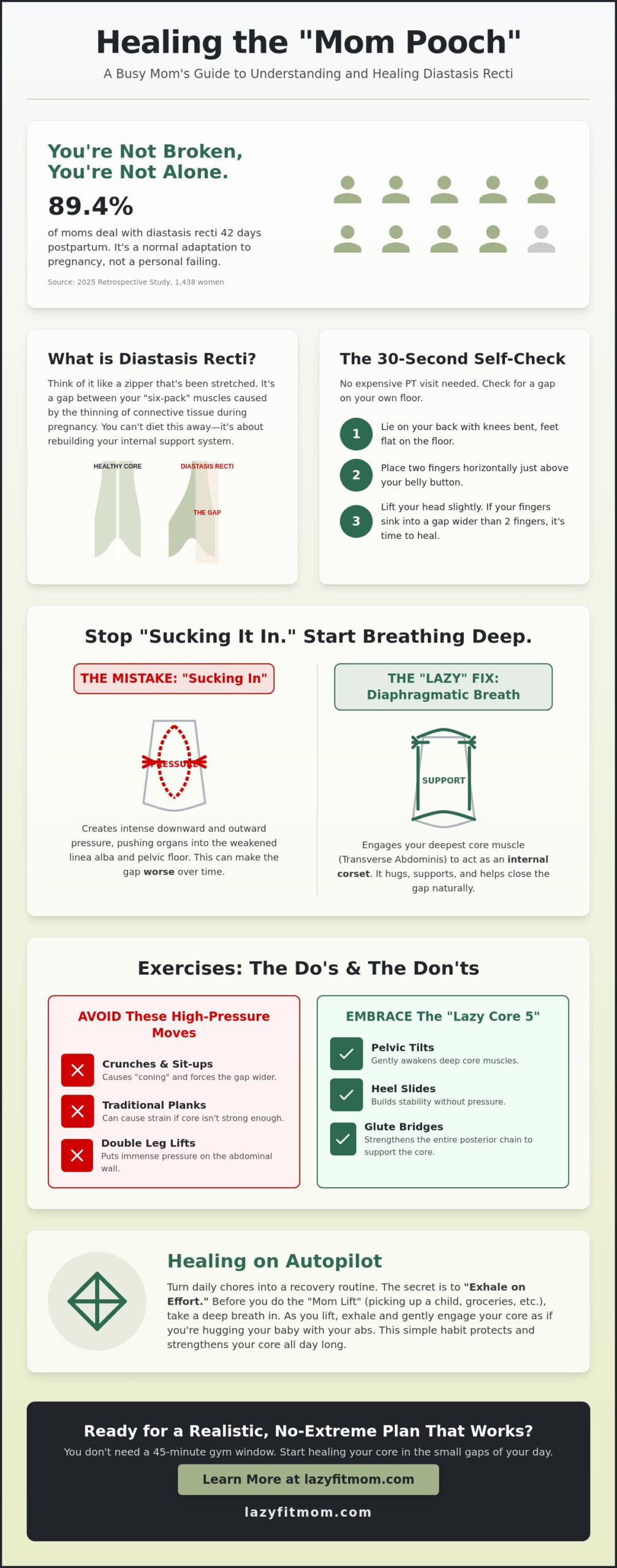
A 2025 retrospective study involving 1,438 women found that a staggering 89.4% of moms deal with diastasis recti at 42 days postpartum. If you feel like your stomach is broken or you’re constantly fighting a mom pooch that won’t budge, you aren’t alone and you definitely aren’t failing. It’s exhausting to think about fitness when you’re already drowning in the mental load of motherhood, especially when a single physical therapy evaluation can cost $275. You don’t need a 45-minute gym window or expensive equipment to start feeling like yourself again. Finding the right exercises for diastasis recti is about working with your body during the small gaps in your day, not against it.
I know you’re tired and the last thing you want is another high-intensity routine that leaves you more depleted. This guide will show you how to heal your abdominal separation and reduce back pain using low-pressure movements that actually fit into a busy life (Realistic, No-Extreme Plan That Works). We’ll walk through a sustainable, lazy-friendly approach to core recovery that focuses on deep muscle engagement rather than sweat-soaked workouts. You’ll learn exactly which moves to avoid and how to rebuild your strength one micro-moment at a time.
Key Takeaways
- Realize your “mom pooch” is a natural adaptation, not a sign you’re “broken,” and can be healed with a realistic, low-pressure approach.
- Learn why “sucking it in” is the worst thing for your gap and how to use deep breathing to engage your internal corset instead.
- Identify “banned” moves like crunches that make abdominal separation worse and find out the truth about the plank debate.
- Master the “Lazy Core 5” exercises for diastasis recti that you can do on your floor with zero equipment or 45-minute gym sessions.
- Turn your daily chores into a recovery routine by learning how to engage your core during the “Mom Lift” and even when getting out of bed.
What is Diastasis Recti? (The “Mom Pooch” Explained)
If you’ve ever looked in the mirror and wondered why you still look four months pregnant, even though your “baby” is now a toddler, you’re likely dealing with Diastasis recti. It sounds clinical and scary; but it’s basically just a fancy term for a gap between your abdominal muscles. Think of it like a zipper that’s been stretched too far. During pregnancy, your connective tissue (the linea alba) thins out to make room for your little human. It’s a brilliant, normal adaptation for baby growth, not a sign that your body is “broken” or that you’ve failed at postpartum life. Every body does this to some degree; but for about 32.6% of women, that gap stays wider than it should be even a year after birth.
Many moms try to diet their way out of this, but here’s the reality: you can’t starve a structural gap. If the tissue between your “six-pack” muscles has lost its tension, no amount of calorie counting or juice cleanses will flatten it. This is why specific exercises for diastasis recti are so much more effective than a standard gym routine. Traditional weight loss focuses on fat, but healing the “pooch” is about rebuilding your internal support system. You’re fixing a foundation, not just trying to fit into old jeans.
Signs You Have Abdominal Separation
The most common sign is the “forever 4 months pregnant” look that doesn’t change regardless of what you eat. You might also notice a strange “coning” or “doming” ridge that pops up down the center of your stomach when you sit up in bed or try to do a crunch. This is your internal organs literally pushing against that thinned-out tissue because your core can’t hold the pressure. If you’re also fighting lower back pain that won’t quit, it’s often because your front isn’t doing its job, forcing your back to overwork just to keep you upright. It’s a heavy mental load to feel disconnected from your own middle.
The 2-Finger Rule for Testing
You don’t need a $275 physical therapy evaluation just to see if you have a gap. You can do a 30-second check right now on your living room floor. Lie on your back with your knees bent and feet flat. Place two fingers horizontally just above your belly button. Slowly lift your head and neck off the floor as if you’re starting a mini-crunch. If you feel a soft, deep space where your fingers sink in between the muscle walls, that’s the gap.
A “normal” gap is usually about one to two finger-widths wide and feels firm, like a trampoline. If yours is wider than two fingers or feels very squishy (like you could push all the way down to your spine), it’s time to focus on targeted exercises for diastasis recti. While most cases can be managed with a “lazy” home routine, stop Googling and see a specialist if you experience sharp pain or bulging that feels hard or painful to the touch. Otherwise, let’s focus on closing that gap from your own carpet.
The Foundation: Why Breathing is Your Most Efficient “Lazy” Exercise
Most fitness experts treat breathing like a thirty second warm up. For a busy mom of two, that’s a massive wasted opportunity. Breathing isn’t just for staying alive; it’s one of the most effective exercises for diastasis recti because it targets the deep muscles you can’t see. When you “suck it in” to hide the pooch, you actually create intense pressure that pushes against your abdominal wall and down on your pelvic floor. It’s like squeezing a balloon in the middle; the air has to go somewhere, and usually, it’s straight into your gap, making the separation worse over time.
Instead of hiding the gap, we want to support it. Your Transverse Abdominis (TVA) is your body’s natural, internal corset. It’s the deepest layer of muscle that wraps around your middle to keep everything tight and supported. According to MedlinePlus on diastasis recti, the condition is a result of the thinning of the tissue that holds these muscles together. Diaphragmatic breathing is the primary tool for internal pressure management. By learning to breathe into your ribs rather than just your chest or belly, you wake up that deep corset without ever leaving your chair (Realistic, No-Extreme Plan That Works).
How to Master Diaphragmatic Breathing
To get this right, use the “Umbrella” visualization. Imagine your ribcage is an umbrella. When you inhale, the umbrella should open 360 degrees, pushing your ribs out to the sides and back, not just your belly forward. As you exhale, imagine the umbrella closing and gently “lifting and squeezing” your pelvic floor. You don’t need a gym for this. You can practice while nursing, waiting for the microwave to beep, or sitting in the school pickup line. If you want a structured way to layer these breaths into a routine, our Postpartum Recovery Program walks you through it step by step.
The Connection Between Posture and Your Gap
The “Mom Slouch” is a real thing. Between carrying a car seat and hunching over a changing table, our pelvis often tilts forward, which keeps the abdominal wall in a constantly stretched, weak position. Healing your gap requires finding a neutral pelvis without trying too hard. Think about tucking your “tail” slightly so your hip bones are stacked directly under your ribs. This simple adjustment for standing takes zero extra time but allows your core to actually rest and recover. It’s the ultimate lazy girl hack; you’re doing exercises for diastasis recti just by standing in line at the grocery store correctly.
Safe vs. Risky: Which Exercises Actually Close the Gap?
Picking the right movements feels like a minefield when you’re already overwhelmed. You might think jumping back into a high-intensity bootcamp is the fastest way to get your body back, but for a separated core, that’s like trying to fix a cracked foundation by adding a second story. The Lazy Fit Mom philosophy is simple: if a movement causes your stomach to “dome” or bulge out, leave it alone. That dome is a signal that your internal pressure is winning and your connective tissue is losing. We prioritize low-impact efficiency over high-intensity burnout every single time (Realistic, No-Extreme Plan That Works).
The plank debate is a perfect example of why traditional fitness advice fails moms. Planks are often called the “gold standard” for core strength, but they can actually make your gap wider if your muscles aren’t ready to handle the gravity. When you’re in a plank, the weight of your internal organs pushes directly against that thin linea alba. If you see a ridge forming or feel your back arching, your core has checked out. It is much safer to stick to exercises for diastasis recti that keep you on your back or all fours until that internal corset is strong enough to hold its own.
Exercises to Avoid (The Red List)
Crunches and sit-ups are officially banned for now. They are the fastest way to push your organs through the gap because they force the abdominal muscles to pull away from each other rather than knitting together. Leg lifts are another common trap; when your core is separated, it can’t stabilize your pelvis, so your lower back takes the entire hit. You should also be careful with intense yoga poses like “Upward Dog” or deep backbends. While they feel like a good stretch, they can overstretch the healing tissue and prevent the gap from closing.
The Green List: What to Do Instead
The most effective exercises for diastasis recti are usually the ones that look the most boring. We focus on modified movements that mimic your daily life, like slow heel slides or pelvic tilts. These “micro-engagements” rebuild your strength without the risk of doming or injury. They don’t require a 45-minute gym window or a sports bra that feels like a suit of armor. If you want a routine that respects your time and your body, check out The Ultimate Lazy Mom Workout Plan to learn how to get fit without even leaving your living room floor. Recovery is about being smart and efficient, not exhausted.
5 Best Exercises for Diastasis Recti (No Equipment Needed)
Forget the 45-minute gym sessions that never happen. When you’re an overwhelmed mom of two, you need results that fit between laundry loads and toddler naps. The “Lazy Core 5” is a set of exercises for diastasis recti designed to be done right on your living room floor or even in bed. We aren’t aiming for high repetitions that leave you gasping for air; we want slow, controlled movements that actually knit your core back together. Consistency (5 minutes daily) beats a 1-hour session once a week every single time.
Safety is our top priority here. During every single rep, keep an eye on your stomach. If you see that “coning” or ridge we talked about earlier, stop and reset your breath. It means your deep core isn’t quite ready for that range of motion yet, and that’s perfectly okay. We’re playing the long game here (Realistic, No-Extreme Plan That Works). By moving slowly, you give your brain time to reconnect with those “hidden” muscles that have been offline since pregnancy.
The “Lazy Core 5” Routine
- 1. Pelvic Tilts: Lie on your back with knees bent. Gently flatten your lower back against the floor by tilting your hips toward your ribs. It’s a tiny, subtle movement that wakes up your internal corset.
- 2. Heel Slides: While lying on your back, slowly slide one heel away from you until your leg is straight, then slide it back. This targets the lower abs without the strain of a traditional leg lift.
- 3. Glute Bridges: Lift your hips toward the ceiling while squeezing your glutes. This builds your posterior chain to support your front, taking the pressure off your separated abs.
- 4. Bird-Dog (Modified): Get on all fours. Instead of lifting an arm and a leg at once, just slide one foot back at a time while keeping your back flat. It’s stability without the wobbly frustration.
- 5. Toe Taps: Lift your legs to a tabletop position. Slowly tap one toe to the floor and bring it back up using your deep core, not your hip flexors. This is the ultimate test for deep core control.
Modifications for the Exhausted Mom
Some days, even getting on the floor feels like climbing a mountain. If you’re completely wiped out, you can do your pelvic tilts while lying in bed before you even get up for the day. If your floor is covered in toys, use a wall for support while standing to do your pelvic tilts and modified bird-dogs. We also live by the “One-Rep Rule”: doing just one rep is infinitely better than doing zero. If you want a structured way to keep yourself accountable without the pressure, join our Private Accountability Group Access to connect with other moms in the trenches. You don’t have to be perfect; you just have to be consistent.
Healing on Autopilot: Making Core Recovery Sustainable for Busy Moms
The biggest mistake most moms make is thinking they need a dedicated “gym hour” to heal. When you’re managing a household and a career, that hour doesn’t exist. Real recovery happens in the kitchen, the laundry room, and the nursery. You have to stop viewing your exercises for diastasis recti as a medical prescription and start seeing them as a lifestyle integration. Every time you perform “The Mom Lift”-picking up a toddler or a heavy basket of wet clothes-you have an opportunity to engage your core. By exhaling and gently drawing your belly button toward your spine before you lift, you’re doing the work without ever setting foot on a yoga mat.
This is a mindset shift from “working out” to “rehab-ing your life.” A 2024 study found that at one year postpartum, 32.6% of women still have a significant gap. Many of these women are doing standard crunches because they don’t realize their daily habits are undoing their progress. If you spend all day hunched over a stroller and then “crunch” up out of bed, you’re putting constant outward pressure on that healing tissue. You don’t need more intensity; you need more efficiency (Realistic, No-Extreme Plan That Works).
The “Log Roll” Technique
The most important habit you can start today is the log roll. Instead of sitting straight up from a lying position, which forces your abs to “dome,” roll onto your side first. Use your arms to push yourself up into a sitting position. This one habit protects your gap 24 hours a day, 7 days a week. It’s the ultimate lazy girl hack because it requires zero extra time. You can even teach your toddler to “help” you by having them climb up the couch themselves rather than you bending over to lift them. This reduces your physical load while you’re still in the early stages of healing.
Next Steps for Your Recovery
Creating a “lazy” schedule is about finding the gaps that already exist. Do your pelvic tilts while the coffee brews or your toe taps while the kids are finally quiet for five minutes. You’ll know you’re ready to progress to more challenging core workouts when you can perform your exercises for diastasis recti without any coning or back pain. Don’t rush the process; your body took nine months to stretch, and it’s okay if it takes a few months to knit back together. If you’re tired of guessing and want a realistic roadmap designed by a busy mom of 2, check out The Lazy Fit Mom Guide for a full plan that actually sticks. You aren’t starting late; you’re starting right where you need to be.
Take Control of Your Core Recovery Today
Healing doesn’t require you to be a fitness expert or spend hours on a workout mat. It’s about the small, smart choices you make from the moment you wake up. We’ve explored how mastering your 360-degree breath and avoiding “doming” movements protects your core while you rebuild that internal support. By focusing on the “Lazy Core 5” and sustainable habits like the log roll, you’re using the most effective exercises for diastasis recti without adding more stress to your daily plate. You aren’t failing; you’re simply learning to work with your body instead of against it.
I’ve been in your shoes, feeling exhausted and wondering if my stomach would ever feel like mine again. As a mom of 2 who successfully lost 25kg in 6 months without a gym or unrealistic routines, I know that 8-minute windows are often all the time we have. You deserve a recovery plan that respects your time and your mental load. Heal your core without the stress-Get The Lazy Fit Mom Guide to access a realistic roadmap that works for your life. You’re doing a great job, and you’re worth the 5 minutes of daily care it takes to feel strong and confident again.
Frequently Asked Questions
Can I ever fully close my diastasis recti gap without surgery?
Yes, you can significantly improve or even “close” the gap through consistent, low-pressure movements. Most medical professionals recommend at least 6 months of conservative management before even considering surgery. While the connective tissue might not always return to its exact pre-baby state, you can restore full function and a flatter appearance by strengthening the deep core muscles. It’s about building a strong “internal corset” that holds everything together effectively.
How long does it take to see results from diastasis recti exercises?
Most women notice a difference in core stability and a reduction in back pain within 6 to 12 weeks of starting a consistent routine. A 2024 study suggests that while 60% of women have separation at six weeks postpartum, that number drops to 32.6% at one year. Real, visible changes to the “pooch” usually happen when you commit to just 5 to 10 minutes of daily engagement rather than sporadic, intense sessions.
Is it too late to fix my abdominal separation if my kids are older?
It is never too late to start exercises for diastasis recti, even if your “baby” is now in middle school. Your muscles and connective tissue still have the ability to strengthen and adapt years after childbirth. I’ve seen moms start their recovery a decade late and still see a flatter stomach and less back pain. The process is exactly the same; you’re simply retraining your brain to connect with those deep core muscles.
Can I do planks if I have diastasis recti?
You should only do planks if you can maintain a flat stomach without any “doming” or bulging down the center. For many moms, a full plank puts too much pressure on the thinned connective tissue, which can actually make the gap wider. Start with modified versions, like planks against a wall or on your knees. Only progress to the floor once you can hold your internal corset tight for 30 seconds straight.
What happens if I ignore my diastasis recti?
Ignoring the separation often leads to chronic lower back pain, pelvic floor dysfunction, and even a higher risk of umbilical hernias. Since your core isn’t supporting your trunk, your back and hips have to do double the work. This leads to that “overwhelmed” feeling of physical exhaustion because your body is literally struggling to stay upright. Fixing the gap is about your long-term health and mobility, not just how you look in a swimsuit.
Will losing weight fix my abdominal separation?
Losing weight might reduce the fat over your muscles, but it won’t fix the structural gap in your connective tissue. You can be at your goal weight and still have a “mom pooch” because the abdominal walls are literally separated. This is why traditional dieting often fails to give you the flat stomach you want. You need specific exercises for diastasis recti to pull those muscle walls back together and restore your core’s integrity.
Can I wear a waist trainer to help close the gap?
Waist trainers are generally not recommended because they do the work for your muscles, causing them to get even weaker over time. They also create intense downward pressure on your pelvic floor and can push your internal organs against the abdominal gap. Instead of a trainer, focus on “internal bracing” using your breath. If you need support for back pain, a light postpartum compression garment is a much safer, low-pressure option.
How do I know if an exercise is making my diastasis recti worse?
The biggest red flag is “coning” or “doming,” where a ridge or peak pops up down the middle of your stomach during a move. This means the internal pressure is too high for your current strength level. If you feel sharp pain in your lower back or a bulging sensation in your pelvic floor, stop immediately. These are clear signs that the exercise is straining the thinned tissue rather than healing it.
Leave a Reply