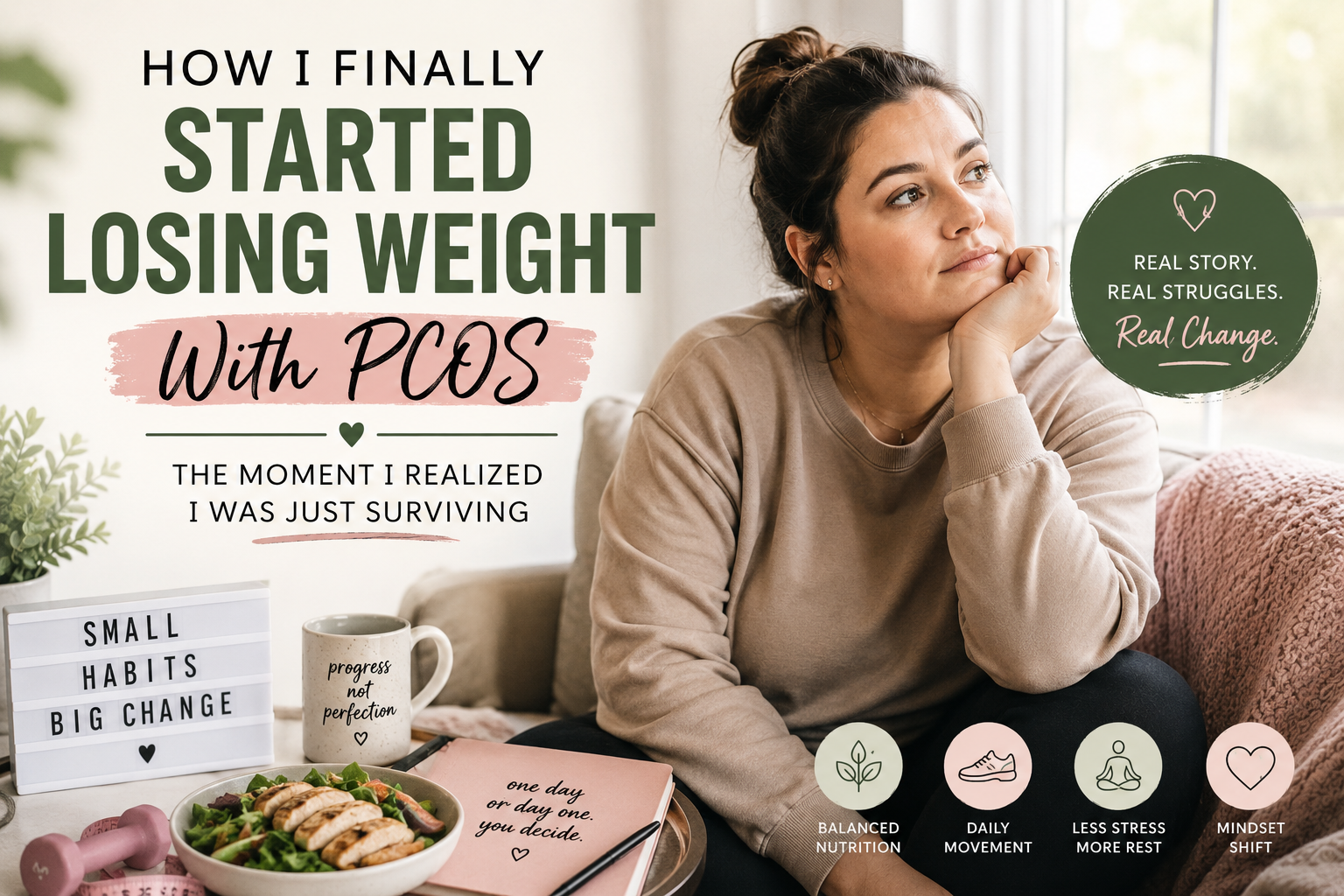
If PCOS leaves you tired all the time, you are not lazy—and you are not alone. Before I lost 25kg, my days were shaped by PCOS fatigue, brain fog, cravings and the 3 p.m. crash.
I didn’t overhaul my entire life. I started with five small habits that helped me feel steadier and made weight loss easier to sustain. Here is what I changed, what improved first and the simplest place to start.
I wasn’t living. I was surviving on my PCOS weight loss journey.
I’d wake up already tired. Skip breakfast because there wasn’t time, or because I just wasn’t hungry — which I now know is its own red flag with PCOS. Coffee for breakfast, coffee for lunch, and somewhere around 3 pm, I’d hit a wall so hard I’d sit in the car in the school pickup line just to have five quiet minutes before I had to be “on” again.
Every evening ended the same way: a wave of guilt. Guilt that I hadn’t moved my body. Guilt that dinner was whatever was fastest. Guilt that I watched other moms seem to have endless energy, while I was counting down to bedtime by 7 pm.
If any of that sounds familiar, I want you to know something before we go any further: this isn’t a willpower problem. Living with PCOS changes how your body handles energy, hunger, and stress — and most of us are never told that. We’re just told to “eat less and move more” and left to wonder why it doesn’t work.
This is the story of my PCOS weight loss journey — not the highlight reel version, but the actual turning point. And if you’re in the thick of it, I hope it gives you somewhere to start tomorrow.
Table of Contents
My PCOS Weight Loss Journey: The Wake-Up Call
There wasn’t one big dramatic moment. It was smaller than that, which somehow made it worse.
My daughter asked me to race her up the stairs, the way we used to. I told her, “Not today, mommy’s tired,” — and she said, “You’re always tired.” She wasn’t being unkind. She was just telling the truth, the way kids do.
That sentence sat with me for days. Not because I felt ashamed — I promised myself early on that shame wasn’t going to be part of this — but because it made something click. I wasn’t tired the way you’re tired after a long day. I was tired in a way that never lifted. That’s when I started paying attention to what else had quietly gotten worse: the cravings, the brain fog, the periods that were unpredictable at best, the way I could do “everything right” for a week and see nothing change.
Those are signs your lifestyle is hurting your PCOS — not because you’re doing something wrong, but because the standard advice was never built for a PCOS body in the first place.
Why PCOS Fatigue Happens (The Part Nobody Explained to Me)
Once I actually looked into it, so much made sense. Here’s the plain-language version of what’s usually going on:
Insulin resistance. Many of us with PCOS have cells that don’t respond to insulin the way they should, so blood sugar and cravings swing more, and the body holds onto fat more easily — regardless of how “good” you’re eating.
Inflammation. PCOS is linked to low-grade inflammation, which can worsen fatigue, mood, and — frustratingly — make weight loss slower even with real effort.
Poor sleep. Hormonal shifts from PCOS can disrupt sleep quality, and poor sleep raises cortisol and hunger hormones the next day. It becomes a loop.
Stress and cortisol. Chronic stress (hello, motherhood) raises cortisol, which can worsen insulin resistance and drive cravings for quick-energy foods.
Blood sugar swings. Skipping meals or living on caffeine causes blood sugar spikes and crashes — which reads to your body as more stress, not less.
None of this is about hormonal imbalance symptoms being your fault. It’s about understanding the system you’re actually working with, so the effort you put in finally goes somewhere.
What I Changed (Five Tiny Habits, Not a Total Overhaul)
I didn’t rebuild my whole life overnight — I didn’t have the energy for that, and honestly, neither do you need to. These were the five small shifts that made the biggest difference:
✓ More protein, especially at breakfast. Protein steadies blood sugar and cuts the mid-morning crash. ✓ 10-minute walks, usually after lunch or dinner — not a workout, just movement that helps insulin sensitivity. ✓ Protecting sleep, even just moving bedtime 30 minutes earlier. ✓ Water first thing in the morning, before coffee. ✓ A little meal prep, so 4 pm-me isn’t relying on 6 am-me’s motivation.
This became my simple PCOS routine — five things, not fifteen. It’s the same approach I built out fully in my PCOS Diet Plan, if you want the next layer once these feel steady.
What Happened
Slowly, and in this order: energy first, mood second, weight change last.
The 3pm wall stopped showing up every day. My cravings got quieter — not gone, just quieter, which felt like getting my brain back. I stopped dreading getting dressed in the morning. And weight did start to shift, gradually, without me ever tracking or restricting in a way that felt punishing.
But honestly? The bigger win was my relationship with food and with myself. I stopped treating “getting through the day” as a win and started actually feeling like I had some room to breathe. That’s what realistic progress looked like for me—not only a change on the scale, but more energy and capacity for everyday life.
Your Action Plan: You can start your PCOS weight loss journey with just one habit tomorrow.
You don’t need all five habits tomorrow. Pick the one that feels lightest, not the one that feels most impressive. For most people, that’s water first thing, or protein at breakfast.
Give it a week before you add anything else. That’s it. That’s the whole ask.
If you want it fully mapped out — meals, movement, sleep, all of it, laid out day by day — my 7-Day Reset is built for exactly this starting point, and my 3-Day Reset is free if you want to test the waters first.
Frequently Asked Questions
Q: Is PCOS fatigue normal?
A: Yes — persistent fatigue is one of the most common and least talked-about PCOS symptoms. It’s usually tied to blood sugar swings, poor sleep quality, and chronic low-grade inflammation, not just “being busy.”
Q: How do I start losing weight with PCOS when nothing has worked before?
A: Start with blood sugar stability, not restriction — protein-forward meals, regular eating windows, and short walks after eating tend to move the needle before calorie-counting ever does.
Q: Can lifestyle changes really help PCOS, or do I need medication?
A: Lifestyle changes can meaningfully improve insulin sensitivity, energy, and symptoms for many women, and often work alongside medication rather than replacing the need to talk to your doctor about your specific case.
Q: What’s a realistic timeline for a PCOS morning routine to make a difference?
A: Most people notice changes in energy and cravings within 1–2 weeks of consistently adopting small habits, with visible weight changes typically occurring several weeks after that.
Where to Go From Here
If you’re ready to take your next small step without the overwhelm, here are a few resources to support your PCOS weight loss journey:
- 🍳 Fix Your Breakfast First: Check out these Easy High-Protein Meal Prep Ideas designed specifically for blood sugar stability and low morning effort.
- 🥗 Get Your Diet Framework: Read my complete PCOS Diet Plan to understand how to build meals that reduce food noise and keep insulin steady.
- ⚡ Take the 7-Day Challenge: Ready for a full week mapped out for you? Grab the 7-Day Reset or test the waters with my free 3-Day PCOS Fat Loss Kickstart.
- 🍳 Automate Your Kitchen: Tired of daily meal-planning fatigue? The PCOS Kitchen Reset System does all the heavy lifting so you don’t have to guess what to eat next.
- 🔬 Learn the Science: Want to dive deeper into how metabolic health impacts hormonal conditions? Read the overview on PCOS and Insulin Resistance from the NIH.
You don’t have to overhaul your entire life this week. You just have to stop surviving it. Pick one link above and start there tomorrow—that is more than enough!
Leave a Reply