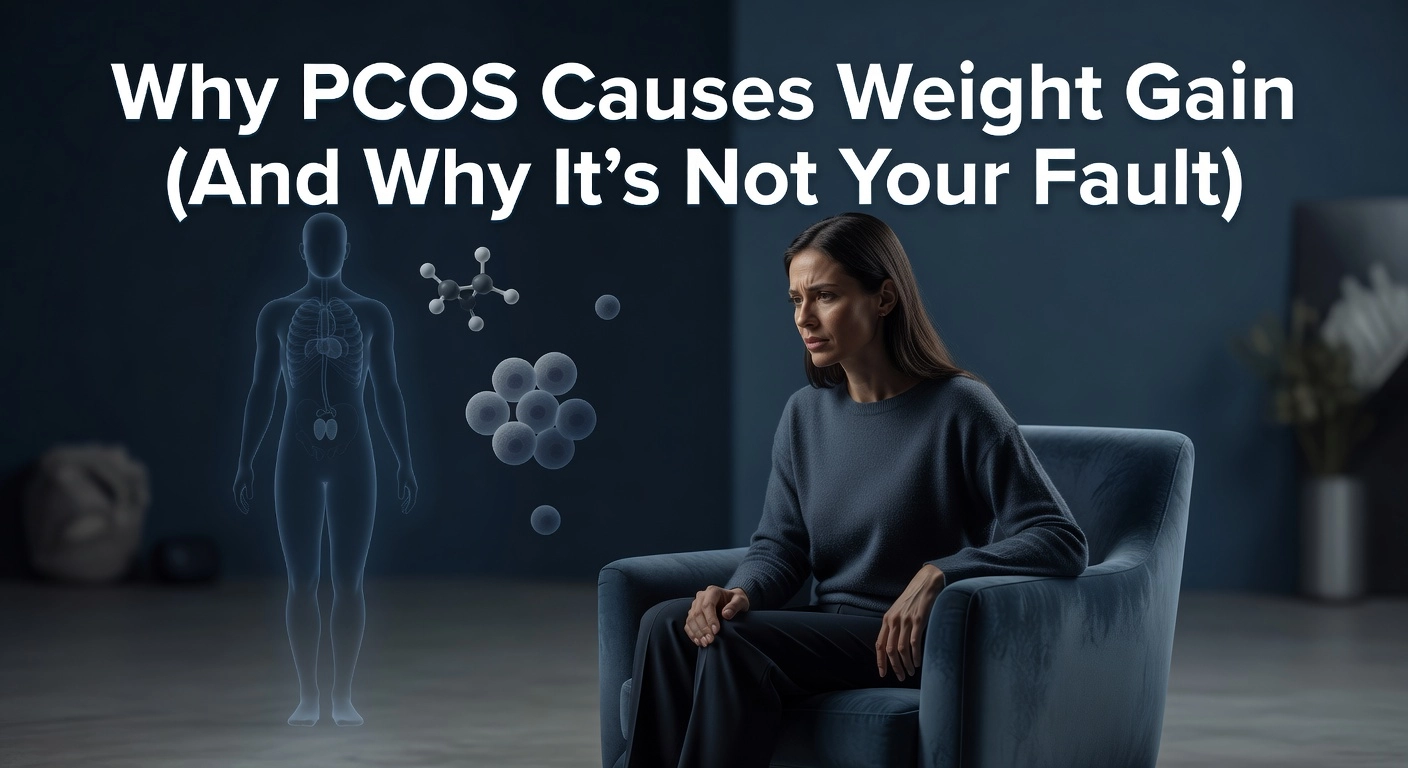
You step on the scale, and the number keeps creeping up. You’re eating well, staying active, doing everything “right,” yet nothing seems to work. If this sounds familiar, you are not alone, and more importantly, you are not failing. There is actually a very real biological reason behind this struggle, and it has a name: PCOS weight gain.
Polycystic ovary syndrome, or PCOS, is one of the most common hormonal conditions affecting women, yet it remains widely misunderstood. Many women spend years blaming themselves for weight changes that are actually driven by hormones, insulin resistance, and other factors completely outside of their control.
In this post, we will break it all down in simple, straightforward terms. You will learn exactly why PCOS makes weight gain so much easier and weight loss so much harder, what is actually happening inside your body, and why this cycle is not a reflection of your willpower or effort. Understanding the “why” is the first step toward finding an approach that actually works for you.
Wait, Is It Still Called PCOS in 2026?
If you’ve been Googling “PCOS weight gain” lately, you might have stumbled across a new term being thrown around: PMOS. And yes, it’s real. In May 2026, the Endocrine Society officially renamed PCOS to Polyendocrine Metabolic Ovarian Syndrome (PMOS), following a massive global consensus process that involved input from over 22,000 people and dozens of medical organizations. This wasn’t just a rebrand for fun. It was a long-overdue acknowledgment that the old name was actually misleading a lot of women and their doctors.
Here’s the thing: “polycystic ovary syndrome” puts all the focus on ovarian cysts, but many women with this condition never actually have cysts. The real issue running the show is insulin resistance and metabolic dysfunction, and the new name finally says that out loud. The Lancet consensus paper00717-8/fulltext) confirms that the rename is designed to center the metabolic and hormonal chaos happening throughout the whole body, not just the ovaries.
This matters so much for understanding weight gain. When the condition is framed as primarily metabolic, it completely reframes why the scale won’t budge no matter how hard you try. Weight gain and metabolic dysfunction aren’t just annoying side effects; they are core features of the condition. That’s exactly why standard “eat less, move more” advice so often fails women with PCOS or PMOS. It doesn’t touch the insulin resistance driving the whole cycle.
The reassuring part? Whether your doctor still says PCOS or has switched to PMOS, nothing about your actual experience changes. The symptoms, the struggles, and the strategies are all the same.
The Real Reason You Can’t Lose Weight With PCOS
Here’s the hard truth: if you’ve been eating less and exercising more but still can’t budge the scale, you are not failing. Your body is working against you on a biological level, and there are actually several reasons why.
PCOS weight gain isn’t about willpower or eating too much cake. It’s a physiological issue driven by multiple overlapping hormonal and metabolic dysfunctions, all happening at the same time. According to research on PCOS weight gain mechanisms, these systems don’t just cause problems individually; they feed into each other in a way that makes your body genuinely resistant to traditional weight loss methods.
Insulin resistance is the biggest piece of the puzzle. Studies suggest it affects somewhere between 75 and 95 percent of women with PCOS, and here’s the part that surprises most people: it can happen even if you’re not overweight. When your cells stop responding properly to insulin, your body pumps out more of it to compensate. All that extra insulin signals your body to store fat, particularly right around your belly, and it makes breaking down existing fat stores incredibly difficult.
Then there are elevated androgens, the “male hormones” that are higher than normal in most women with PCOS. These directly drive fat toward your abdominal area and mess with the brain signals that control how hungry you feel.
On top of that, many women with PCOS also deal with leptin resistance. Leptin is the hormone that tells your brain, “Okay, you’re full, stop eating.” When your brain stops hearing that signal properly, you feel hungry almost constantly, regardless of how much you’ve actually eaten.
Finally, chronic low-grade inflammation documented in PCOS research further slows your metabolism and makes fat loss even harder. All four of these issues, insulin resistance, high androgens, leptin resistance, and inflammation, constantly reinforce each other. That’s exactly why cutting calories alone rarely works for women with PCOS. You have to address the root causes, not just the number on the plate.
Insulin Resistance Is the Biggest Culprit
Let’s get into the actual biology here, because once you understand what’s happening inside your body, it starts to make so much more sense why the usual “eat less, move more” advice just doesn’t cut it with PCOS.
Insulin is a hormone your body releases after you eat to help move sugar from your blood into your cells for energy. When you have insulin resistance, your cells basically stop listening to that signal. So your pancreas thinks, “Fine, I’ll just send MORE insulin,” and keeps pumping it out, trying to get the job done. The problem? High insulin levels directly tell your body to store fat, especially around your belly. That stubborn midsection weight so many of us with PCOS struggle with? This is a big reason why it parks itself right there.
Here’s where it gets even more frustrating. Insulin doesn’t just store fat, it also suppresses glucagon, which is the hormone responsible for breaking stored fat back down into energy. So when insulin is chronically elevated, your body essentially loses access to its fat-burning switch. You’re locked into storage mode, and your body genuinely cannot tap into those fat reserves the way it normally would.
This is exactly why you can be eating in a calorie deficit and still feel like the scale is completely frozen. Your body isn’t broken, and you are not doing anything wrong. It’s just that calories in versus calories out doesn’t account for the hormonal environment your cells are operating in. According to Allara Health, insulin resistance is present in up to 95% of people who have PCOS with obesity, and even 75% of those without it.
Yes, eating sugary foods and simple carbs makes insulin spikes worse and can intensify the whole cycle. But it’s really important to know that the root issue is the insulin resistance itself, not a character flaw or a lack of discipline. That distinction matters because it changes how you approach solutions. Instead of punishing yourself with extreme restriction, the goal is to support your insulin levels through sustainable habits, like protein-forward meals, reducing blood sugar spikes, and understanding your PCOS from the ground up.
Elevated Androgens Make You Hungrier (Yes, Really)
If insulin resistance is the engine driving PCOS weight gain, then elevated androgens are the fuel keeping it running. And this is where things get really frustrating, because these hormones mess with your hunger in ways that feel completely out of your control.
Hyperandrogenism basically means your body is producing higher-than-normal levels of male-pattern hormones like testosterone. This is one of the defining features of PCOS, and beyond causing things like acne, extra facial hair, and irregular periods, it directly affects the part of your brain that controls appetite. According to research on why PCOS causes constant hunger, androgens activate appetite centers in the hypothalamus, making you feel hungry more often and more intensely than someone without PCOS would.
Here’s the part that explains so much: higher androgen levels are specifically linked to cravings for calorie-dense foods, especially refined carbs, sweets, and fatty foods. This is not a willpower problem. Your hormones are literally pushing you toward the cookies and the chips. Research even suggests that testosterone may influence reward pathways in the brain, making those foods feel more compelling and harder to resist.
Androgens also tell your body to store fat in your abdomen rather than your hips or thighs. That stubborn belly fat is not just a cosmetic concern; it is metabolically active tissue that releases inflammatory molecules and free fatty acids, which then worsen your insulin resistance. And once insulin resistance gets worse, your ovaries produce even more androgens. More androgens mean more belly fat, more cravings, and more hunger. It is a genuinely vicious cycle, and understanding it is the first step to breaking it.
Broken Hunger Signals and a Slower Metabolism
On top of the insulin and androgen chaos we just covered, there is another layer making weight loss with PCOS genuinely harder: broken hunger signals and a metabolism that is not quite firing on all cylinders.
Leptin is the hormone responsible for telling your brain, “Okay, we’re full, stop eating.” It is produced by your fat cells and acts like a messenger to your hypothalamus. The problem is that many women with PCOS have a condition called leptin resistance, where the brain simply stops responding to those messages properly. Your leptin levels can actually be elevated, meaning your body is technically sending the signal, but the brain just is not receiving it. The result? You finish a full meal and still feel hungry. That is not a lack of willpower. That is a communication breakdown happening at the hormonal level.
It gets a little more complicated because PCOS is also linked to chronic low-grade inflammation. Think of it as your immune system running on a low simmer all the time. This constant activation raises cortisol, your primary stress hormone, which then pushes your body to store more fat, particularly around the belly. Cortisol also suppresses your resting metabolic rate, meaning your body burns fewer calories even when you are doing nothing.
Research supports that women with PCOS can have a measurably slower metabolism compared to women without the condition, especially when insulin resistance and inflammation are both in the picture.
Here is the most important thing to take away from all of this: this is a biology problem, not a motivation problem. Understanding that your hunger cues are unreliable and your metabolism is running slower than it should actually changes everything about how you approach weight loss with PCOS.
Why PCOS Weight Gain Hits Different When You Are a Busy Mom
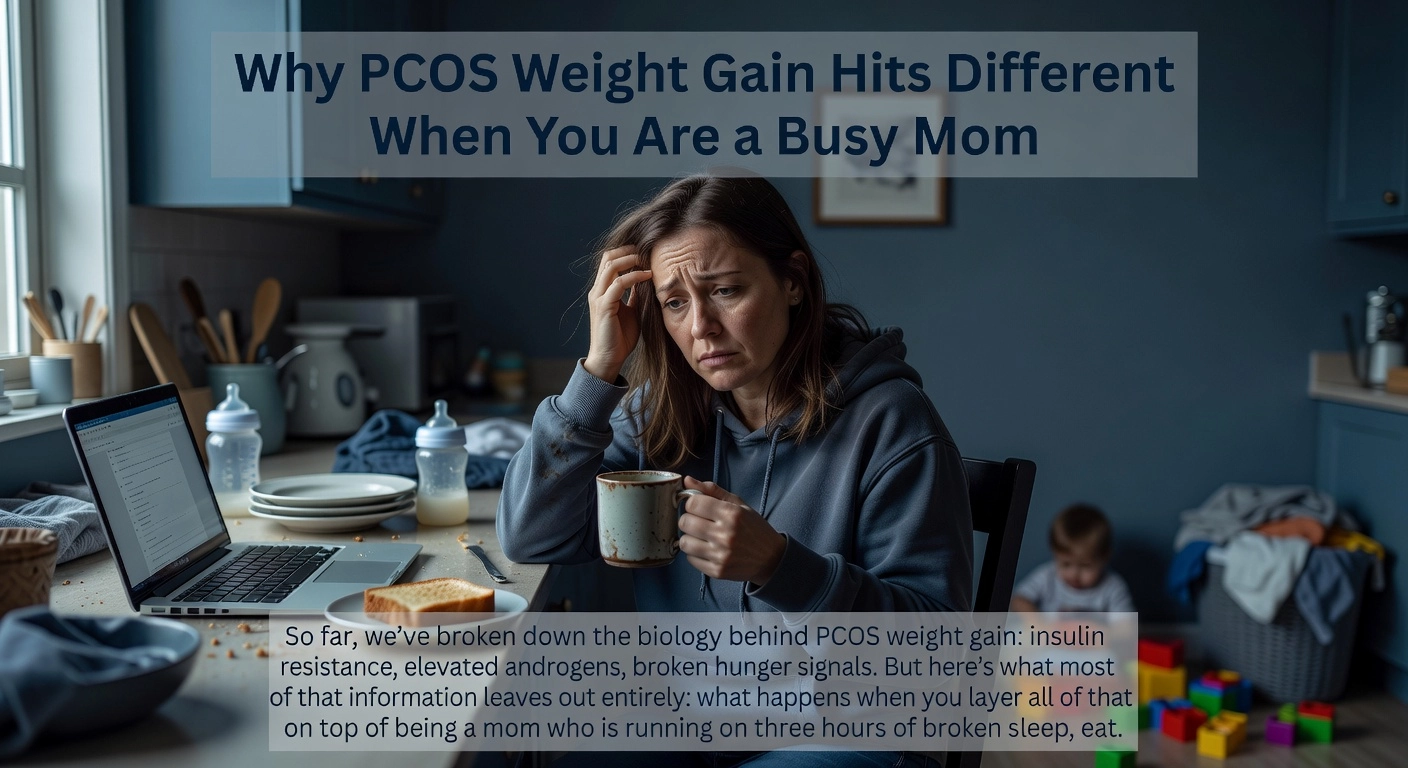
So far, we’ve broken down the biology behind PCOS weight gain: insulin resistance, elevated androgens, and broken hunger signals. But here’s what most of that information leaves out entirely: what happens when you layer all of that on top of being a mom who is running on three hours of broken sleep, eating cold dinosaur nuggets over the sink, and hasn’t had five minutes to herself since 2022.
Because that changes everything.
Sleep deprivation is not just tiredness. When you are waking up with kids through the night, your body responds by cranking up cortisol and ghrelin (your hunger hormone) while dialing down leptin (your “I’m full” signal). Research consistently shows that poor sleep drives increased appetite and cravings, particularly for high-sugar and high-fat foods. For someone with PCOS who already has disrupted leptin and ghrelin signaling due to insulin resistance, this is a double hit. Your body is getting the message to eat more, and it is coming from two directions at once.
Then add parenting stress on top. Cortisol, the stress hormone, does not just make you feel frazzled. It actively promotes fat storage in your abdomen and pushes you toward comfort foods. Moms with PCOS are already biologically prone to abdominal weight gain, and chronic parenting stress essentially keeps pouring gasoline on that fire all day long.
Here is one nobody talks about: finishing your kid’s leftovers. The half-eaten grilled cheese, the crackers off the toddler’s plate, and the last three bites of mac and cheese because throwing food away feels wasteful. These invisible calories add up fast, and for someone with PCOS whose body is already primed to store rather than burn, they matter more than you would think.
And by the time dinner rolls around, decision fatigue has wiped out whatever mental energy you had for making a healthy choice. The mental load of motherhood, the scheduling, the planning, the emotional management, it is cognitively exhausting. That exhaustion is exactly why so many moms with PCOS end up reaching for whatever is easiest at 7pm.
The postpartum period adds another layer entirely. Hormonal shifts after delivery can actually unmask or worsen PCOS symptoms, meaning some women feel like their body completely changed after having a baby, and they are right. Research confirms that women with PCOS experience distinct patterns of weight retention postpartum that make this phase especially difficult to navigate.
Most PCOS advice completely ignores all of this. It was not written for someone managing a toddler meltdown while trying to meal prep. That is exactly why this blog exists.
Table of Contents
The Good News: You Do Not Need to Lose Much for Things to Shift
Here is something that might genuinely change how you feel about this whole journey: you do not need to lose a dramatic amount of weight for your body to start cooperating with you again.
Research consistently shows that losing just 5 percent of your body weight can meaningfully improve insulin sensitivity, reduce androgen levels, and even restore ovulation. According to the NHS, that modest reduction can lead to significant improvements across a range of PCOS symptoms. And a 2025 review in the Journal of Personalized Medicine found that even a 4 to 5 percent loss paired with a low-glycemic diet was linked to a threefold improvement in whole-body insulin sensitivity. That is not a typo. Three times better insulin response from a relatively small change.
So what does 5 percent actually look like in real life? For a 160-pound woman, that is just 8 pounds. Not 50 pounds. Not a complete body transformation. Eight pounds. When you frame it that way, the goal suddenly feels a lot less overwhelming than what you see plastered across social media.
What makes this even more encouraging is that you do not have to wait until you hit that 8-pound mark to start feeling better. Symptom improvements like reduced cravings, more regular cycles, better energy, and clearer skin can begin appearing before major weight loss even shows up on the scale. That happens because small, consistent changes start stabilizing your blood sugar and lowering inflammation right away, and your hormones begin to respond.
This is why shifting your mindset from “I need to lose weight” to “I want to improve my metabolic health” is actually a strategy, not just feel-good talk. When the goal is metabolic improvement, every good meal, every decent night of sleep, and every short walk counts as a win. That removes an enormous layer of pressure and makes it so much easier to stay consistent over time.
Small, sustained changes also outperform aggressive short-term diets for PCOS specifically. Crash diets spike cortisol, and research from PMC confirms that hormonal balance in PCOS is deeply sensitive to stress responses. Higher cortisol promotes more fat storage and worsens insulin resistance, which sets off the exact restrict-binge cycle that is so hard to escape when your hunger signals are already dysregulated. Slow and steady is not just motivational advice here; it is genuinely the smarter biological approach for a PCOS body.
What Actually Works for PCOS Weight Gain
So now that you understand why PCOS makes weight loss so hard, let’s talk about what actually moves the needle. Current evidence points to three core pillars that work especially well together: protein-first eating, sustainable consistency, and holistic lifestyle habits. You do not need all three perfectly dialed in from day one. Even leaning into just one can create real, measurable metabolic improvements over time.
High-protein eating is now the leading strategy recommended by PCOS-focused dietitians, and the clinical data backs it up. A 2024 meta-analysis of eight clinical trials found that high-protein diets significantly reduced fasting insulin and improved insulin resistance markers in women with PCOS. One trial showed roughly 30% more fat loss compared to a standard diet. Aiming for around 25 to 30% of your calories from protein, or roughly 1.2 to 1.6 grams per kilogram of body weight, helps stabilize blood sugar, crush cravings, and keep you fuller for longer.
But protein alone is not the whole picture. The second pillar is consistency over perfection, which honestly might be the most important one for busy moms. A few reliable habits repeated most days will always outperform a perfect plan you cannot stick to. Pair that with holistic habits like short walks, better sleep, and stress reduction, and these pillars start reinforcing each other in ways that make the whole thing feel less overwhelming and more like real life.
Protein-First Eating Is the Lazy Mom’s Best Friend With PCOS
Of all the strategies for managing PCOS weight gain, protein is the one that actually works with your broken biology instead of against it. And the best part? It is genuinely one of the laziest approaches out there, because there is no elaborate system to follow. You just put protein on your plate first, every single time.
The current evidence-based target for women with PCOS is 25 to 30 percent of your daily calories from protein, which works out to roughly 1.2 to 1.6 grams per kilogram of body weight. That number might sound technical, but in practice it simply means making protein the star of every meal rather than an afterthought. One clinical trial found that women with PCOS following a high-protein diet lost approximately 30 percent more body fat compared to women eating a standard diet, even when total calories were similar. That is a meaningful difference, and it comes down to how protein specifically targets the biological chaos driving your weight gain.
Here is why it works so well for PCOS specifically. When you eat protein, it slows digestion and blunts the blood sugar spike that would otherwise send your insulin levels surging. Remember, insulin resistance is the core problem here, so anything that reduces those spikes is directly attacking the root cause, not just managing calories on the surface. Protein also triggers the release of satiety hormones called PYY and CCK, which are the hormones that tell your brain you are full and satisfied. For women with PCOS, where leptin signaling is already disrupted and hunger hormones run wild, this is genuinely game-changing.
The practical approach could not be simpler. Before you add anything else to your plate, pick your protein first: eggs, Greek yogurt, cottage cheese, canned tuna or salmon, rotisserie chicken, or legumes like lentils and chickpeas. That is the whole strategy.
Starting with breakfast matters most. Research consistently shows that hitting 30 grams of protein at breakfast significantly reduces cravings and overall calorie intake for the rest of the day. A Greek yogurt with some cottage cheese mixed in, a couple of eggs with a side of smoked salmon, or even a high-protein smoothie can get you there without much effort at all.
Consistency Beats Perfection Every Single Time
Here is something that trips up so many women with PCOS: the belief that a perfect plan followed perfectly is the only path forward. It is not. In fact, that kind of thinking is often what makes things worse.
Rigid diet plans, think strict calorie deficits, total carb elimination, or aggressive fasting windows, actually trigger a cortisol spike in your body. And if you have been reading along, you already know that cortisol is the last thing your PCOS needs more of. High cortisol disrupts sleep, ramps up androgen production, and pushes your body straight into the restrict-binge cycle that makes insulin resistance even harder to manage. The more extreme the plan, the more your body fights back.
This is exactly why the lazy approach works so well. Rotating through the same three or four reliable high-protein meals week after week is not boring. It is actually a metabolic strategy. When you already know what you are eating, you remove the decision fatigue that tanks your best intentions at 6pm when you are exhausted and everyone is hungry. One clinical trial found that higher protein intake led to roughly 30% more fat loss compared to a standard diet. Consistency with simple meals is how you capture that benefit without burning out.
A Sunday batch cook does not have to be elaborate. Roasting a tray of chicken thighs, browning some ground turkey, and boiling a dozen eggs covers most of your week. Sheet-pan chicken thighs and ground turkey taco bowls are especially good choices because the whole family eats them too, which means you are not making two separate dinners after a long day.
And when life happens, because it will, eating the birthday cake or surviving a chaotic week on drive-through does not erase anything. You just return to basics the next morning. That is the whole strategy.
Movement, Sleep, and Stress Are Not Optional Extras
Diet is genuinely the foundation when it comes to PCOS weight gain, but if you stop there, you are leaving a lot of progress on the table. Movement, sleep, and stress management are not bonus activities you squeeze in when life slows down. They are active hormonal levers, and ignoring them is a bit like fixing a leaky faucet but leaving the main pipe cracked.
When it comes to movement, strength training two to three times per week is the real MVP for PCOS. It improves insulin sensitivity more effectively than cardio alone because muscle tissue acts like a sponge for glucose, soaking up blood sugar without needing as much insulin to do it. It also preserves lean muscle mass, which keeps your resting metabolic rate higher even on the days you do absolutely nothing. You do not need an intense gym session either; even a 30-minute home workout with resistance bands counts.
But on the days you cannot manage a proper workout, a 20-minute walk still does real work. Research shows that regular walking improves glucose metabolism, lowers cortisol, and supports better insulin response, all without requiring a gym membership, a babysitter, or any special equipment. A walk around the block after dinner genuinely helps.
Sleep is the one most busy moms sacrifice first, and with PCOS it is one of the most costly trade-offs. Losing even one or two hours raises ghrelin (your hunger hormone) by up to 24 percent and measurably worsens glucose tolerance. That is not just tiredness; that is your body actively fighting your weight loss efforts the next day.
Stress works the same way. Chronically high cortisol promotes abdominal fat storage and cranks up cravings. But you do not need a meditation retreat to fix this. Five minutes of intentional breathing, a short phone-free walk, or simply committing to a consistent bedtime all create real, measurable hormonal shifts.
Each of these topics deserves a much deeper dive than a single paragraph allows, and they each have dedicated posts right here on lazyfitmom.com where we get into the practical details in a way that actually fits real mom life.
A Week of Lazy High-Protein Meals That Actually Work for PCOS
Talking about what to actually eat can feel overwhelming, so let’s make it as simple as possible. Here is a sample day that covers your protein goals without requiring much thought or effort.
Breakfast starts with a Greek yogurt parfait, plain full-fat or 2% Greek yogurt with a scoop of vanilla protein powder stirred right in, topped with berries and a small handful of nuts. That combination lands you around 30 grams of protein before you even get the kids out the door. Lunch is rotisserie chicken pulled straight from the store container and laid over a bag of pre-washed greens, drizzled with olive oil and a pinch of salt. Done in under three minutes. Dinner is a sheet-pan situation: chicken or turkey sausage links tossed with broccoli, bell peppers, and zucchini, roasted at 400 degrees while you help with homework.
On days when even that feels like too much, lean on zero-prep options completely. Cottage cheese with berries, deli turkey slices wrapped around a cheese stick, hard-boiled eggs from a pre-peeled bag, or a protein shake blended with frozen fruit, spinach, and a spoonful of nut butter all count as real meals that support blood sugar stability and keep cravings in check.
For the ultimate lazy win, slow cooker dump meals change everything. Before school drop-off, throw raw chicken thighs, a jar of salsa, and a can of black beans into the slow cooker on low. By pickup time, dinner is already shredded and ready. Turkey meatballs in marinara with added zucchini work the same way.
The best part is that the whole family eats the same food. Turkey meatball bowls, chicken quesadillas loaded with rotisserie chicken and beans, and egg fried rice with edamame stirred in are kid-approved without any separate cooking.
For complete shopping lists and full meal plans built around exactly this approach, check out the lazy PCOS recipe guides over at lazyfitmom.com. The whole point is this: eating well for PCOS does not have to be complicated, expensive, or time-consuming to actually work.
Your Body Has a Reason, and Small Changes Actually Work
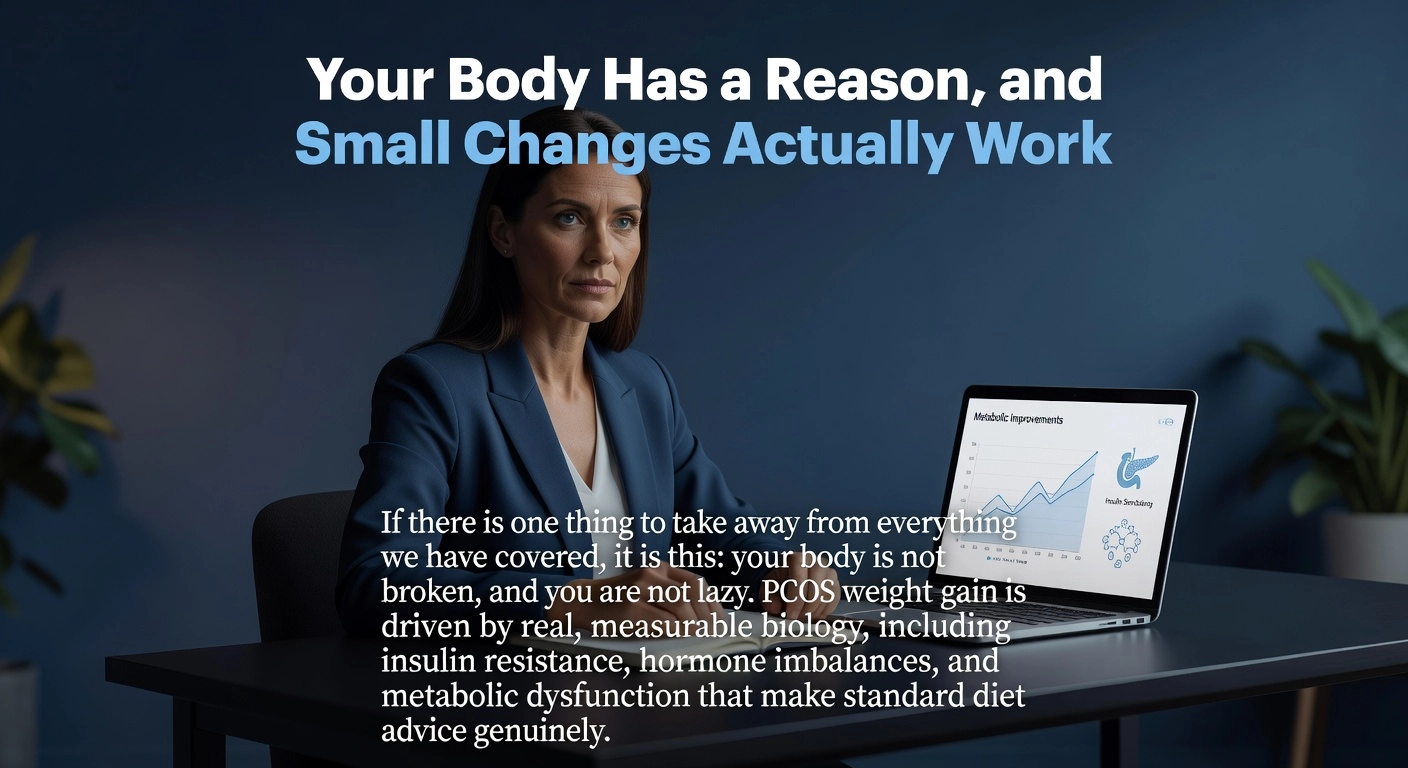
If there is one thing to take away from everything we have covered, it is this: your body is not broken, and you are not lazy. PCOS weight gain is driven by real, measurable biology, including insulin resistance, hormone imbalances, and metabolic dysfunction that make standard diet advice genuinely ineffective for you. That is not an excuse; it is a reason, and knowing the reason changes everything about how you approach this.
The three things that actually move the needle are simple. Losing just 5% of your body weight can meaningfully shift your hormones and insulin levels. Eating protein first at every meal works with your body instead of against it. And showing up consistently, even imperfectly, beats any perfect plan you abandon by Wednesday.
You do not need to overhaul your entire life. You need a few habits that actually survive school pickups, toddler chaos, and the days when dinner is whatever is fastest. That is enough. That counts.
If you are a busy mom figuring this out one messy day at a time, you are already making progress just by understanding what is really going on. Browse the lazy high-protein PCOS recipes on the site, follow along on Instagram for quick meal ideas, or save the lazy PCOS meal plan to get started this week. Small steps, done repeatedly, are how this works.
Conclusion
Living with PCOS weight gain is genuinely difficult, but understanding what is happening in your body changes everything. Here is what we covered today: PCOS disrupts hormones in ways that make weight gain almost inevitable, insulin resistance makes your body store fat more aggressively, and the cycle is biological, not a personal failure on your part.
You are not lazy. You are not lacking discipline. You are working against a system that is fighting back.
The good news is that knowledge is power. Once you understand the root cause, you can stop chasing generic advice and start pursuing strategies that actually work for your body.
Ready to take the next step? Speak with a healthcare provider who specializes in PCOS and explore treatment options tailored to you. Your breakthrough starts with understanding, and you have already begun.
⚡ Take the Guesswork Out of PCOS Weight Gain
Reversing hormonal weight gain doesn’t mean resorting to extreme restriction or grueling workouts that leave you exhausted. Work with your body instead of against it by layering in these simple, mom-tested steps and low-stress shortcuts:
📚 More Practical PCOS Weight Loss Guides
- The Full Blueprint: Discover our step-by-step PCOS Diet Plan for Weight Loss designed to fit into real mom life.
- Real Motivation: Read my raw, personal story on How I Lost 25kg in 6 Months with PCOS without losing my mind.
- Gentle Low-Impact Cardio: Learn how simple daily movement lowers cortisol and tackles insulin resistance with our guide on Walking for PCOS.
- Smart Morning Fuel: Discover how to satisfy your appetite and manage morning blood sugar spikes: Are Oats Good for PCOS?
🛠️ Grab Your PCOS Fat Loss Shortcuts & Toolkits
Take the overwhelm, planning, and exhausting calculations out of your week with these ready-to-use digital resources:
- 🎁 Free Download: Start resetting your daily momentum with our completely free 3-Day PCOS Fat Loss Kickstart.
- 🍳 Clean Up Your Kitchen: Ready to organize your grocery shopping without losing your mind? Grab The LazyFitMom PCOS Kitchen Reset System to streamline your meals.
- 🔄 The Complete Daily Tracker: Stop spinning your wheels and build bulletproof consistency with the 30-Day PCOS Fatloss Routine For Busy Moms.
- ⏱️ The Quick Lifestyle Shift: Short on time and low on energy? Reset your baseline habits in just one week with our 7-Day Lazy Fat Loss Reset for PCOS Moms.
Leave a Reply