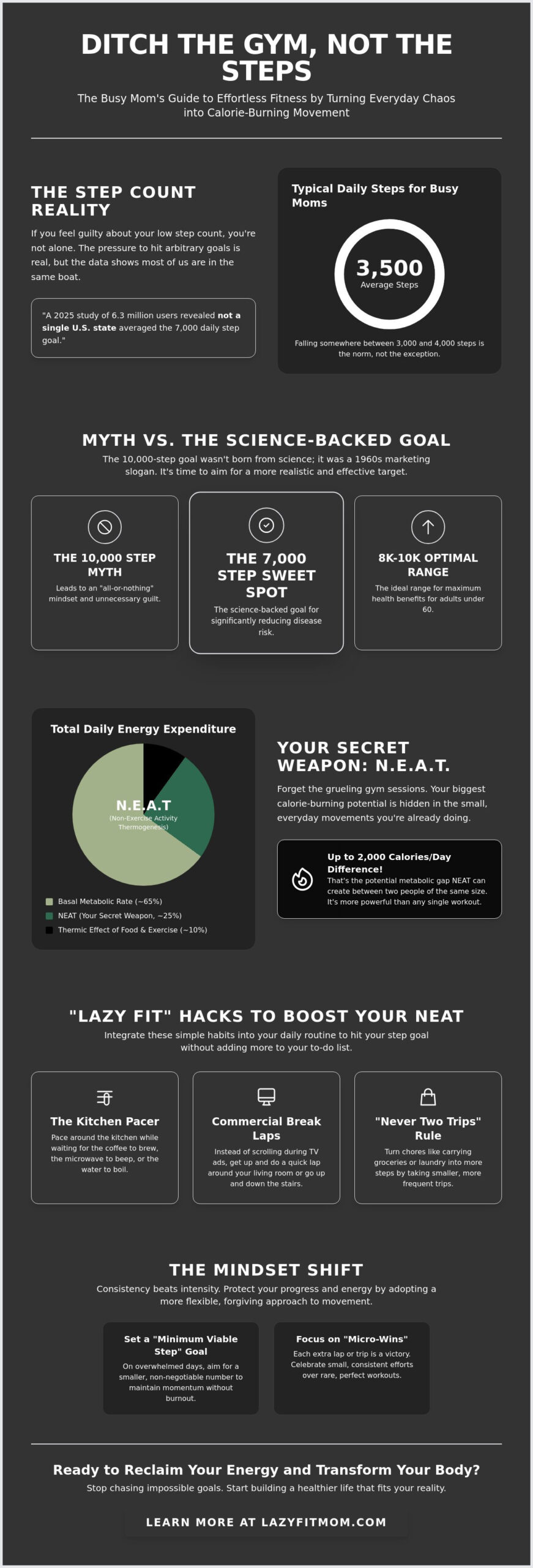
In 2025, a study of 6.3 million users revealed that not a single U.S. state averaged the 7,000 daily step goal. If you’re feeling guilty because your fitness tracker is judging you, it’s time to stop. Most of us are stuck between 3,000 and 4,000 steps while drowning in “mom brain” and endless piles of laundry. You probably think fitness requires a gym membership or a dedicated hour of “me time” to see any real progress. (Spoiler: You really don’t.) Learning how to get more steps with daily habits isn’t about adding more work to your plate; it’s about reclaiming the movement already hidden in your chaotic routine.
I get it because I’ve been there, staring at a step count of 1,200 at 4:00 PM while feeling completely drained. You want the weight loss and the energy, but the idea of “exercise” feels like just one more chore you can’t handle. I promise you can skyrocket your daily movement without ever stepping foot in a gym or losing a second of sleep. This guide will show you how to use Non-Exercise Activity Thermogenesis (NEAT) to turn your normal “mom life” into a calorie-burning machine. We’re going to debunk the 10k myth and find a realistic way for you to stay active that actually fits your life.
Key Takeaways
- Discover why the 10,000-step goal is actually a marketing myth and how aiming for a science-backed “sweet spot” of 7,000 steps can still transform your health.
- Learn how to get more steps with daily “Lazy Girl” habits like the Kitchen Pacer and the Commercial Break Lap to burn calories without a gym membership.
- Master the “Never Two Trips” reversal to turn simple chores like laundry and groceries into effortless, high-efficiency step-count boosters.
- Understand the power of NEAT and why small, frequent movements throughout your chaotic day are more effective for weight loss than a single intense workout.
- Set a “Minimum Viable Step” goal to protect your progress and keep your momentum going even on your most overwhelmed, high-fatigue days.
Why the 10,000 Step Goal Feels Impossible for Moms (And Why It’s Not Your Fault)
Let’s be honest; 10,000 steps feels like a mountain when you’ve already climbed a literal pile of laundry today. For most of us, that number isn’t a “goal,” it’s a source of guilt. We often fall into the all-or-nothing trap where we think if we can’t hit the big 10k, there’s no point in trying at all. This perfectionist standard is exactly why so many moms give up before they even start. It’s not your fault that a marketing slogan from the 1960s doesn’t fit into your 2026 reality. Learning how to get more steps with daily life is about reclaiming small pockets of movement rather than finding an extra hour you simply don’t have.
The biggest barrier isn’t actually your legs; it’s the mental load. When your brain is already managing school schedules, meal prep, and work deadlines, “getting steps” feels like one more chore on a never-ending list. We need to shift the focus from extreme effort to simple efficiency. Recent research indicates that for adults under 60, the optimal range for health benefits is between 8,000 and 10,000 steps. For many, the “sweet spot” for significant disease risk reduction is actually around 7,000 steps. By Understanding NEAT, or Non-Exercise Activity Thermogenesis, we can see that movement doesn’t have to be formal to be effective. It’s about the energy you spend doing everything except sleeping and eating.
The Myth of the ‘Perfect’ Workout
Waiting for a child-free hour at the gym is a recipe for inconsistency. If your fitness plan requires a babysitter and a commute, it’s going to fail on the days you’re most tired. The Lazy Fit Mom philosophy rejects the high-intensity burnout that leaves you too sore to chase a toddler. We prioritize radical realism over aesthetic performance. Sustainable movement is any activity that doesn’t require a wardrobe change.
Breaking the ‘Sedentary Mom’ Cycle
We all have “dead zones” in our day where steps disappear into thin air. These are the moments we spend stationary without even realizing it. Identifying these gaps is the first step toward a higher count. Consider these common sedentary traps:
- Scrolling through social media while the kids play nearby.
- Standing still while waiting for the coffee to brew or the microwave to beep.
- Sitting in the car five minutes early for school pickup.
The psychological benefit of “micro-wins” in your step count cannot be overstated. Instead of viewing walking as “exercise,” start seeing it as sanity maintenance. Taking three laps around the kitchen island while the nuggets cook isn’t just about the calories; it’s about breaking the cycle of fatigue. When you figure out how to get more steps with daily micro-movements, you’ll find you actually have more energy at the end of the day, not less.
The Lazy Girl’s Secret: Understanding NEAT and Why It Beats the Gym
NEAT stands for Non-Exercise Activity Thermogenesis. It sounds like a complex medical term, but it’s actually the ultimate weight loss hack for the overwhelmed parent. Essentially, NEAT is every single calorie you burn that isn’t from sleeping, eating, or formal exercise. For a busy mom of 2, this is where the magic happens. Most fitness influencers tell you that you need a grueling hour at the gym to see results. In reality, that one hour of “Exercise Activity” usually only accounts for about 5% of your total daily energy expenditure. The other 95% comes from your resting metabolism and, most importantly, your NEAT.
Research shows that differences in NEAT can account for a variance of up to 2,000 calories per day between two people of the same size. That is a massive gap that no 45-minute spin class can bridge. It means that finding how to get more steps with daily chores is actually more powerful for your metabolism than any treadmill session. (And it’s way less exhausting for your “mom brain” to manage.) When you focus on small movements, you’re building a body that burns fat around the clock without the post-workout burnout.
NEAT vs. EAT: Which One Actually Burns More?
EAT is the formal workout you probably dread. While it has its place, it often leads to a “post-workout” slump where you spend the rest of the day on the couch because you’re wiped out. A Lazy mom workout plan prioritizes NEAT to avoid this exhaustion. Data from 2025 reveals that a 145-pound person burns about 174 calories per hour while standing, compared to just 102 while seated. Over a year, that simple shift could equal over 18,000 calories, which is roughly five pounds of fat lost just by sitting less. If you’re looking for more ways to move without the sweat, check out our guide on floor-based movement for those days you just can’t stand up.
The Cortisol Connection
High-intensity interval training (HIIT) is often marketed as the best way to burn fat, but for stressed moms, it can backfire. Intense workouts spike cortisol, the stress hormone that tells your body to hold onto postpartum belly fat. Gentle movement does the opposite. It helps regulate your nervous system and can even reduce “mom rage” by lowering your heart rate. Citing the health benefits of walking, medical experts note that regular steps can improve your mood and reduce anxiety. It’s the “lazy” way to stay fit without triggering a massive hunger spike or a hormonal crash. When you master how to get more steps with daily habits, you’re choosing a metabolic strategy that actually works with your busy life instead of fighting against it.
5 Realistic Ways to Get More Steps with Daily ‘Mom Life’ Habits
Most fitness advice tells you to park at the back of the parking lot; but they’ve clearly never tried to wrangle a screaming toddler and a heavy car seat across a busy asphalt desert. If you want to know how to get more steps with daily life, you have to look at the tiny, invisible moments inside your own home. Stop standing still during the transition periods of your day. The ‘Kitchen Pacer’ habit is a total game changer. The average microwave cycle lasts about 2 minutes. Instead of staring at the spinning plate, pace around your kitchen island or walk to the front door and back. You can easily clock 150 to 200 steps before the timer even beeps.
Apply this same logic to the ‘Phone Call Wander.’ Never take a call while sitting on the sofa. Whether it’s a catch-up with your best friend or a 15-minute hold time with the pediatrician’s office, keep your feet moving. You can also use your kids as your personal trainers through ‘Parenting Pedometer Boosters.’ A quick game of tag or hide and seek in the backyard counts as your daily cardio. If you’re headed to the park, try ‘Stroller Sprints.’ This isn’t about running until you’re breathless; it’s simply walking at a brisk, intentional pace for 30 seconds while pushing the stroller. These micro-bursts of activity are how to get more steps with daily routines without ever feeling like you’re “working out.”
The ‘One-Trip’ Habit You Need to Break
We’ve been conditioned to be hyper-efficient. We carry twelve grocery bags on one arm like a pack mule just to save time. But being “lazy” and efficient with chores is actually killing your step count. Try the ‘Never Two Trips’ rule reversal. Bring the groceries in one or two bags at a time. If you have 10 bags, that’s five mini-walks instead of one. The Harvard T.H. Chan School of Public Health notes that Walking for Exercise is effective even in short, frequent bouts throughout the day. Apply this to laundry too. Instead of carrying the whole basket, take one stack of shirts to the drawer, then come back for the pants. It feels counterintuitive, but it’s the easiest way to hit your goals without a gym.
Habit Stacking for Busy Parents
Habit stacking is adding a new movement to something you already do every single day. It eliminates the need for willpower because the trigger is already there. Try the ‘Pee and Pace’ rule: every time you use the bathroom, take a 2-minute lap around the house before returning to your tasks. If you use the bathroom 6 times a day, that’s an extra 1,200 steps added to your total with zero extra planning. Habit stacking turns your existing schedule into a fitness plan that requires no extra brain power.
Indoor Step Hacks: Hitting Your Goal Without Leaving the House
Most generic fitness articles tell you to “park further away” to get your movement in. If you’ve ever tried to navigate a rainy parking lot with a toddler on one hip and three bags of groceries on the other, you know that advice is a nightmare. To really master how to get more steps with daily life, you have to look inside your own four walls. You don’t need a sidewalk or a park to hit your goals. Your living room is a perfectly good track if you stop seeing it as a place where you’re only allowed to sit. The ‘Commercial Break Lap’ is my favorite way to sneak in movement. If you’re watching a 30-minute show, you’re likely sitting through 8 minutes of ads. Instead of scrolling on your phone, walk around the sofa until your show comes back. You can easily clock 700 steps before the episode even ends.
If you have stairs, stop being “efficient” by piling things at the bottom to take up later. This is the ‘Multi-Level Movement’ hack. Take every item up as soon as you find it. It might feel like more work, but it’s actually just free steps that require zero extra time in your schedule. For those who want to commit to the “lazy” lifestyle, a walking pad is the best investment you’ll ever make. You can slide it under the sofa and pull it out while you’re catching up on emails or watching Netflix. It turns a sedentary hour into a 4,000-step victory without you ever having to put on real shoes.
Maximizing the ‘Smallest’ Spaces
You can get 1,000 steps without ever leaving your living room. It sounds impossible, but it’s just about changing your cadence. Put on a playlist with a high tempo and do the ‘Toy Tidy’ shuffle. Instead of cleaning up all at once, pick up one toy at a time and walk it back to the bin. It turns a boring chore into a 500-step game. If you’re feeling a mid-afternoon slump, try a ‘Hallway Sprint’ with the kids. Two minutes of tag in the hallway gives everyone an energy boost and pads your tracker nicely.
The ‘Waiting Room’ Mentality
We spend a huge portion of our lives waiting. Whether it’s at the doctor’s office, the school pickup line, or waiting for the laundry to finish, these are prime walking opportunities. Stop sitting and scrolling. Standing and pacing is significantly better for your core stability than slouching in a chair. You can even check out our home abs training to learn how to engage your midsection while you pace. Turning “waiting time” into “walking time” is exactly how to get more steps with daily habits that stick. If you’re ready to stop feeling guilty and start seeing results, start your lazy fitness journey today and join our community of moms who are reclaiming their health one step at a time.
How to Stay Consistent When You’re Tired, Overwhelmed, and ‘Lazy’
Consistency is the ultimate hurdle when you’re managing a household and a “mom brain” that feels like it has 47 tabs open at once. Most fitness experts suggest keeping a detailed daily step diary, but who has time for more paperwork? If you want to know how to get more steps with daily success, you have to lower the bar. I use a “Minimum Viable Step” (MVS) goal of 3,000 steps. On days when the baby is teething or work is exploding, hitting 3,000 is a massive victory. It keeps the habit alive without triggering the “I failed” spiral that usually leads to a week of sitting on the couch.
Technology should be your silent partner, not another chore. Don’t worry about manual logs; use a smartwatch or a simple phone app that tracks your movement passively. This is the “lazy” way to stay aware of your progress without any extra effort. When you see your numbers climbing, it provides a hit of dopamine that makes you want to keep going. Our Lazy Fit Mom community is built on this exact brand of radical realism. We offer accountability without the intimidating “gym bro” vibe, focusing on sisterhood and shared struggle rather than perfectionist standards.
Forgiving the ‘Zero’ Days
One bad day does not ruin your progress. If you had a sedentary day where you barely broke 1,000 steps, let it go. The “Lazy Girl” mindset is built on efficiency and sustainability; if it’s not easy, we won’t do it. So, we make it easy to restart. Don’t try to “make up” for missed steps by doing double the next day. Just go back to your basic how to get more steps with daily habits. Restarting without the guilt is the secret to long-term success. I lost 25kg in 6 months not by being perfect, but by being persistent enough to start again every time I stumbled.
Your 12-Week Step Evolution
Avoid the fatigue trap by increasing your count gradually. Try adding just 500 steps to your daily average each week. This slow evolution prevents the extreme exhaustion that often comes with new fitness routines. Over 12 weeks, those tiny increments add up to an extra 6,000 steps a day. You’ll start noticing non-scale victories like deeper sleep, higher energy levels, and a significant reduction in that foggy “mom brain” feeling. If you’re ready for a structured, low-stress transformation that actually fits your chaotic life, Grab The Lazy Fit Mom Guide and start your journey today.
Your Stress-Free Step Transformation Starts Now
You’ve officially discovered that hitting a healthier movement goal doesn’t require a treadmill or a babysitter. It’s about the small, “lazy” choices you make while waiting for coffee to brew or putting away the never-ending piles of laundry. By breaking the “one-trip” habit and embracing indoor hacks like the Commercial Break Lap, you’re doing more for your metabolic health than an occasional, exhausting gym session could ever achieve. These tiny shifts in your routine are exactly how to get more steps with daily habits that actually stick.
I know you’re busy and overwhelmed because I’m a busy mom of 2, just like you. I used these exact methods to lose 25kg in 6 months without ever stepping foot in a gym or following an unrealistic routine. You don’t have to be perfect to see results; you just have to be willing to move in the messy, chaotic middle of your real life. Stop waiting for the “perfect” time to start and embrace the radical realism of the lazy girl lifestyle.
Start your stress-free fitness journey with The Lazy Fit Mom Guide! You’ve got the tools; now it’s time to take that first easy step toward feeling like yourself again.
Frequently Asked Questions
Is walking actually enough to lose weight after having a baby?
Walking is one of the most effective tools for postpartum weight loss because it doesn’t spike cortisol. High-intensity workouts can often trigger “mom rage” and extreme hunger, but a steady walking routine burns fat without the hormonal crash. A 2024 analysis shows that consistent, low-impact movement can burn up to 200 calories per hour for a 150-pound woman. It’s a sustainable way to see results without feeling even more drained.
What if I can’t even hit 5,000 steps right now?
Start exactly where you are and ignore the 10,000-step myth. If you’re currently at 2,000 steps, aiming for 2,500 is a massive win for your health. Research from 2025 indicates that significant health benefits, including a 40% reduction in mortality risk, actually begin at just 4,400 steps per day. Focus on small, 500-step weekly increases rather than trying to double your count overnight while you’re already exhausted.
Do indoor steps count as much as outdoor walking?
Your body doesn’t know the difference between a hallway and a hiking trail. Every step you take contributes to your daily energy expenditure and helps regulate your blood sugar levels. Indoor steps are actually a “Lazy Girl” secret because they don’t require a diaper bag or a weather check. Learning how to get more steps with daily indoor habits, like pacing during microwave cycles, is just as effective as a formal walk.
How do I get more steps with a newborn or toddler in tow?
Babywearing is your secret weapon for hitting your goals with a newborn. Carrying a 10-pound baby adds natural resistance, which can increase your calorie burn by approximately 15% compared to walking alone. For toddlers, turn clean-up time into a game. Put away toys one by one instead of using a basket. This simple shift turns a 10-minute chore into a 400-step boost without you ever leaving the playroom.
Which fitness tracker is best for busy moms who forget to charge things?
The best tracker is the one you don’t have to think about. If you’re overwhelmed, stick to the health app already on your smartphone. Since most people carry their phones for 90% of the day, it’s a reliable, zero-effort tool that never needs an extra charging cable. If you prefer a wearable, look for basic models with 7-day to 10-day battery lives so you aren’t tethered to a charger every night.
Can I get my steps in while ‘lazy’ scrolling on my phone?
You can absolutely pace around your kitchen or living room while catching up on social media. This “scroll and stroll” method turns a sedentary habit into an active one without requiring any extra willpower. If you spend 20 minutes a day scrolling, walking at a slow pace during that time can add 1,500 steps to your count. It’s the ultimate way to learn how to get more steps with daily screen time.
How many steps should a postpartum mom aim for daily?
Aim for a “sweet spot” of 7,000 steps rather than the arbitrary 10,000 mark. A 2021 study published in JAMA Network Open found that people taking at least 7,000 steps per day had a 50% to 70% lower risk of premature death. However, if you’re in the early weeks of recovery, 3,000 steps is a perfect “Minimum Viable Goal” to keep you moving without causing physical overexertion.
What happens if I miss my step goal for a few days?
Absolutely nothing bad happens if you miss a few days. Your fitness isn’t a streak that resets to zero; it’s a cumulative effort over weeks and months. In a 30-day month, having five “lazy” days won’t ruin your progress as long as you return to your routine on day six. Forgive yourself immediately and focus on hitting your minimum goal tomorrow morning without any added guilt.
Leave a Reply