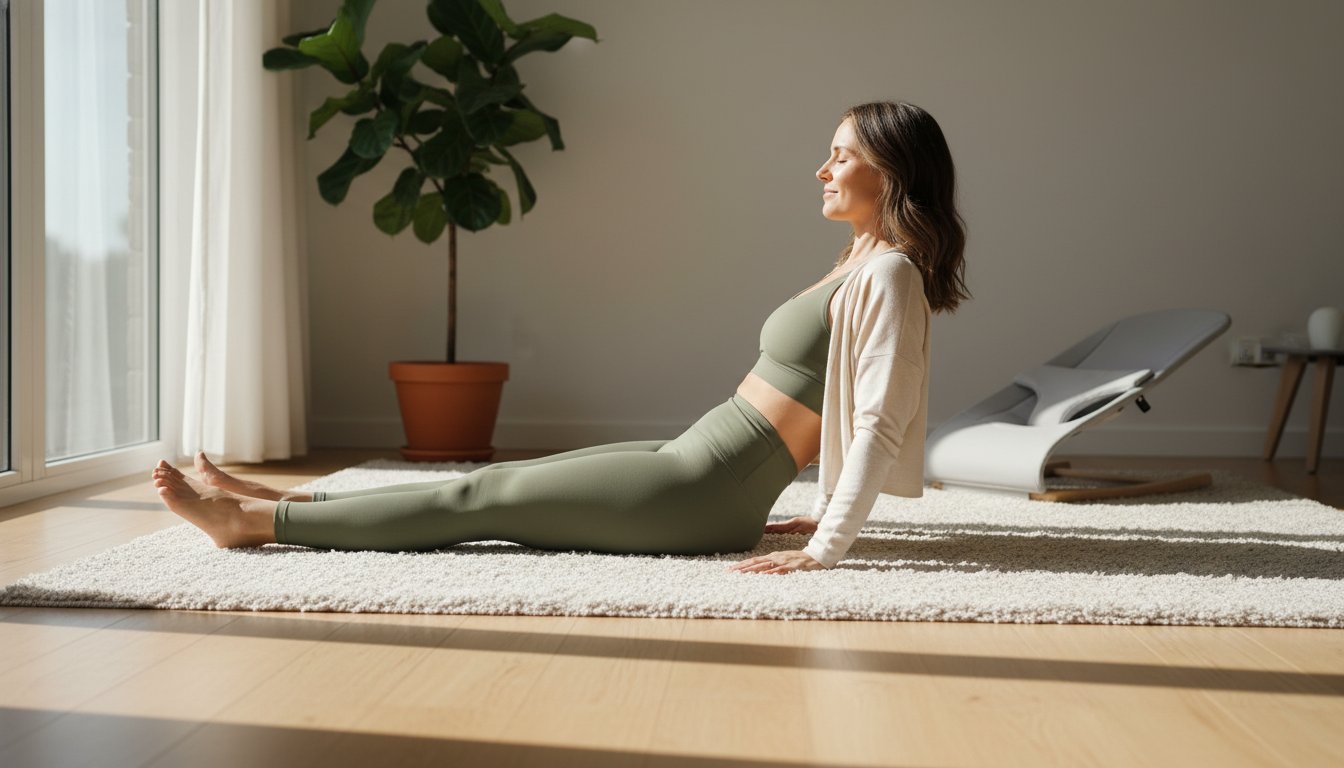
What if the most effective way to “get your body back” is actually to lie down on your living room rug and breathe? If you’re currently staring at a pile of laundry while feeling like a total stranger in your own skin, you aren’t alone. I agree that the pressure to “snap back” is toxic and completely unrealistic (and we’re officially done with it). You’re likely tired, overwhelmed, and worried that a stray jumping jack might worsen your diastasis recti. I’ve been there as a busy mom of 2; I know you need a postpartum workout plan for beginners that doesn’t demand “beast mode” when you’re running on caffeine and zero sleep.
This guide promises a path to safely rebuild your strength and heal your core using a low-pressure, floor-based plan designed for the reality of your recovery. We’ll preview the gentle movements that reduce back pain and help you feel like yourself again. You’ll learn how to meet the 150-minute weekly activity standard recommended by the American College of Obstetricians and Gynecologists (ACOG) without the stress of a rigid routine. It’s time to prioritize your healing, especially since 2026 data shows that 19.18% of us face postpartum mental health challenges that deserve grace, not a grueling gym schedule.
Key Takeaways
- Learn why the 6-week checkup is just a starting point and how to identify the specific signs that your body is ready for gentle movement.
- Discover the Core 3 foundations of a postpartum workout plan for beginners that heals your abdominal gap without high-pressure exercises.
- Understand how low-impact movement protects your joints from Relaxin while keeping cortisol levels low to support sustainable weight loss.
- Get a 10-minute floor routine you can do anywhere; focusing on quality movement to prevent injury and rebuild strength safely.
- Master the One Minute Rule to stay consistent with your recovery even when you’re feeling too busy or overwhelmed to function.
When Is It Actually Safe to Start a Postpartum Workout Plan?
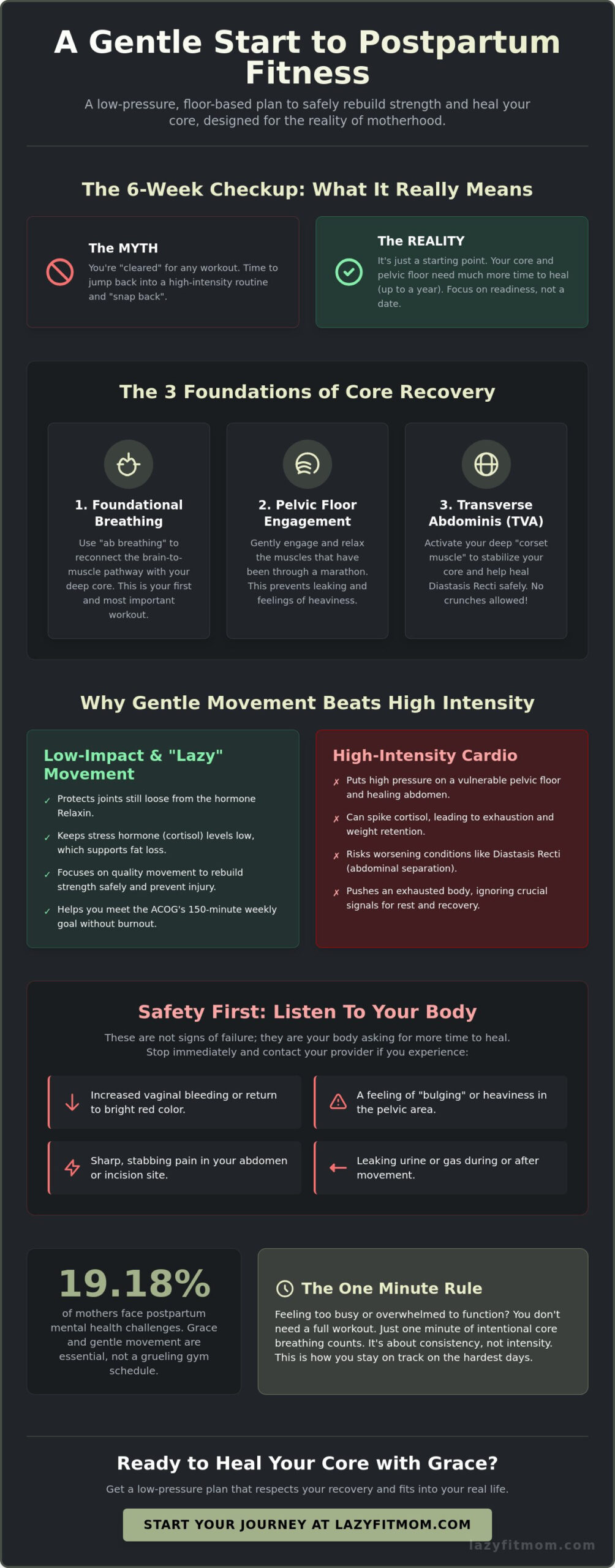
Most of us are told that once we hit the six-week mark, we’re magically ready to jump back into a gym routine. It’s a total myth. That “all clear” from your doctor usually means your uterus has shrunk and your incisions are closed, but it doesn’t mean your core is ready for a HIIT class or a heavy lifting session. The postpartum period is a long, complex phase of healing that can last up to a full year. You need a postpartum workout plan for beginners that respects your unique timeline, not a calendar date someone else picked for you.
There’s a massive difference between being “cleared for activity” and being “ready for impact.” Your doctor might give you the green light to move, but that doesn’t mean your pelvic floor is ready to handle the pressure of running or jumping. You have to advocate for yourself during that checkup. Ask specific questions like, “Can you check me for diastasis recti?” or “Is my C-section scar healing internally as well as externally?” If you feel any pressure, pain, or “heaviness” in your pelvis, it’s a sign to slow down immediately. According to a 2026 systematic review, even though the goal is 150 minutes of activity per week, the first few months are about recovery, not intensity.
The “Lazy” Threshold: Assessing Your Energy
Being “tired” is a valid reason to skip a workout. In our world of radical realism, we don’t push through bone-deep exhaustion just to check a box. If you’re running on two hours of broken sleep, a postpartum workout plan for beginners should look like a gentle stretch or a 5-minute walk, not a sweat session. You need to distinguish between healthy muscle fatigue and dangerous exhaustion. If your heart is racing just from standing up or you feel dizzy, your body is telling you to rest. We’re “starting late” in 2026 because we prioritize long-term health over short-term “snapping back.”
Safety First: Post C-Section vs. Vaginal Delivery
If you had a C-section, remember that you’ve had major abdominal surgery. You should protect your incision by avoiding any movement that pulls or strains your midsection for at least 8 to 12 weeks. Even if you had a vaginal delivery, your pelvic floor has still been through a marathon. Every beginner should start with floor-based breathing regardless of how their baby arrived. Here are a few signs that you should stop moving and call your provider:
- Increased vaginal bleeding or a change in color back to bright red.
- Sharp, stabbing pain in your abdomen or at your incision site.
- Leaking urine or gas during movement.
- A feeling of “bulging” or heaviness in the pelvic area.
Listen to these cues. They aren’t failures; they’re your body’s way of asking for more time to heal. Healing “in” is the only way to eventually get back to the high-energy life you want.
The 3 Foundations of a Beginner Postpartum Routine
If your first instinct is to start doing crunches to fix your “mummy tummy,” please stop right now. Standard crunches are actually the enemy of a postpartum belly because they put too much outward pressure on muscles that are already stretched thin. A real postpartum workout plan for beginners starts with the “Core 3”: your breathing, your pelvic floor, and your transverse abdominis (the deep corset muscle). After nine months of your body growing a human, your brain has literally forgotten how to talk to these muscles. You need to reconnect that neural pathway before you ever pick up a weight or head to a class.
The secret to this connection is ab breathing. It isn’t just “taking a breath”; it’s a specific way to engage your deep core from the inside out. Experts at the Mayo Clinic suggest that Exercise after pregnancy should focus on these foundational movements to prevent long-term injury. This is the first “workout” you’ll do, and the best part is you can do it while lying in bed (total Lazy Girl win). Rebuilding this foundation is what helps you feel like “yourself” again without the stress of a rigid routine.
Diastasis Recti: Checking the Gap
Checking for abdominal separation doesn’t have to be scary. Lie on your back, knees bent, and gently lift your head while pressing two fingers just above your belly button. If you feel a soft gap where your fingers sink in, that’s Diastasis Recti. Don’t panic. Closing the gap completely is less important than creating “functional tension.” This means when you move, that space stays firm rather than doming or coning. If you see that “loaf of bread” shape popping up during movement, avoid planks, sit-ups, or heavy twisting. Focus on the deep core first.
Pelvic Floor: More Than Just Kegels
If you’ve experienced weak pelvic floor symptoms like leaking when you sneeze or a constant feeling of pressure, you’re part of the 33% of women who deal with this after birth. The Lazy Girl way to fix this is to practice “releasing” just as much as “contracting.” A tight, stressed pelvic floor is just as weak as a loose one. Lie down, relax your jaw, and imagine your pelvic floor blossoming like a flower as you inhale. This relaxation is the secret sauce to a successful postpartum workout plan for beginners. If you want a structured way to rebuild, my Postpartum Recovery Program breaks these movements down into 5-minute daily wins.
Why Low-Impact “Lazy” Movement Beats High-Intensity Cardio
If you think you need to sweat for an hour to see results, I have great news for you. You don’t. In fact, for an exhausted new parent, “grinding” through a high-intensity workout can actually backfire. When you’re running on broken sleep, your cortisol levels (the stress hormone) are already through the roof. Adding a grueling cardio session tells your body it’s under even more stress, which often triggers it to hold onto fat for survival rather than burning it. A postpartum workout plan for beginners should prioritize lowering stress, not adding to it. By choosing low-impact, 8-minute sessions, you get the metabolic benefits without the hormonal crash.
Safety is another huge reason to keep things low-impact. During pregnancy, your body produces a hormone called Relaxin to soften your ligaments. Research shows this hormone can stay in your system for up to 5 or 6 months after delivery, making your joints feel like jelly. Jumping or running too soon is a recipe for a sprained ankle or worse. Following the ACOG postpartum exercise guidelines means finding a balance that respects your physical limits. You don’t even need to stand up to get fit; floor-based movements are the ultimate “Lazy Girl” hack for rebuilding strength while staying close to your baby.
The Problem with “Snap Back” Culture
We need to talk about those social media “snap back” photos. They’re often edited, staged, or represent the top 1% of genetic outliers. Trying to match those standards is a fast track to burnout and guilt. As a busy mom of 2, I found that slow progress is the only kind that actually sticks. I lost 25kg in 6 months by embracing the “Lazy Fit Mom” identity, which is all about high efficiency and zero ego. It’s about being smart, not being a martyr. If you only have energy for a few stretches today, that’s a win, not a failure.
Incidental Exercise: Making Motherhood the Workout
You don’t need a gym when your daily life is already a workout. You can turn ordinary chores into “stealth” fitness sessions without adding a single minute to your to-do list. Consider these realistic options:
- Baby-wearing: Carrying your baby in a wrap or carrier adds 10 to 20 pounds of natural resistance to your daily steps.
- Stroller Core Work: Focus on keeping your spine tall and your deep core engaged while pushing the stroller on your afternoon walk.
- Laundry Squats: Every time you reach for a piece of clothing in the basket, do a slow, controlled squat to wake up your glutes.
- Floor Play: While your baby is doing tummy time, get on the rug with them and practice your deep breathing or gentle cat-cow stretches.
This postpartum workout plan for beginners isn’t about finding extra time you don’t have. It’s about using the 1,440 minutes you already have more effectively.
The 10-Minute Beginner Postpartum Floor Routine
You don’t need a gym membership or fancy equipment to start feeling like yourself again. This 10-minute routine is the heart of a realistic postpartum workout plan for beginners, and you can do it right on your living room rug while your baby naps. We’re focusing entirely on floor-based moves to keep the pressure off your joints and your mental load low. Quality over quantity is essential because precise, controlled movements ensure your deep core heals correctly without placing dangerous strain on your weakened lower back. If you’ve had a C-section or experience pelvic pain, please keep your movements small and pain-free.
Step 1: Pelvic Tilts and Diaphragmatic Breathing
Start by lying on your back with your knees bent. Find a neutral spine by making sure there’s a tiny, natural space between your lower back and the floor. Practice the 360-degree breath: inhale into your ribs, back, and belly, then exhale while gently drawing your navel toward your spine. Beginners often make the mistake of “tucking” the pelvis too hard using their butt muscles. Keep it subtle. The goal is to wake up the deep core, not to perform a high-intensity glute squeeze.
Step 2: Heel Slides and Glute Bridges
Heel slides are the best way to wake up lower abs without the risk of a traditional sit-up. While exhaling, slowly slide one heel away from you along the floor, then pull it back. If you feel your back arching or “doming” in your stomach, don’t slide your foot as far next time. Follow this with glute bridges to tackle that nagging postpartum back pain. Strengthening your glutes takes the load off your spine and helps stabilize your pelvis. Here are a few ways to keep it “Lazy Girl” friendly:
- Do your heel slides while watching your favorite show.
- Keep your head and shoulders relaxed on the floor at all times.
- Focus on a slow, 4-second count for every repetition.
Step 3: Modified Bird-Dog for Stability
Flip over to your hands and knees for the final move. Instead of lifting your arm and leg at the same time (which can be too much for a healing core), just slide one leg back while keeping your toes on the floor. Focus on keeping your hips level like a tray of coffee is sitting on your back. As you get stronger over the next few weeks, you can progress to lifting the foot an inch off the ground. This move builds incredible spinal support without any high-impact stress.
This routine works perfectly when you pair it with the Ultimate Lazy Mom Workout Plan for a full-body approach that stays on the floor. If you’re ready for a step-by-step guide that takes the guesswork out of your recovery, check out my 12-Week Home Workout Series to start your journey today.
Staying Consistent When You Are Overwhelmed
I know what you’re thinking. “Consistency” sounds like a scary word when you haven’t slept more than four hours in a row for three months. But here’s the secret: consistency doesn’t mean perfection. It just means showing up for yourself in whatever tiny way you can manage today. I live by the “One Minute Rule.” If the thought of a postpartum workout plan for beginners feels like too much, just commit to one single minute. Lie on the floor. Take three deep breaths. Most of the time, once you’re down there, you’ll end up doing five minutes. If you don’t? That one minute still counts as a win because you kept the promise to yourself.
You can also use habit stacking to fit movement into the chaos of domestic life. Instead of trying to find a dedicated “gym hour” that doesn’t exist, attach your exercises to things you’re already doing. Do three pelvic tilts while you’re waiting for the microwave to beep. Practice your deep core engagement while you’re brushing your teeth. This is why a postpartum fitness guide for busy moms should always focus on grace rather than grit. We aren’t training for a marathon; we’re training to pick up a car seat without our backs giving out. Build a no-judgment support system by finding friends who celebrate these small shifts instead of pushing for “beast mode.”
The Power of “Good Enough”
We have to reject the “all or nothing” mentality that leads to total burnout. In 2026, we’re embracing the power of “good enough” as a sustainable lifestyle. A 5-minute stretch session is infinitely better than a 0-minute workout. It keeps the neural pathways alive without draining your limited battery. Start celebrating non-scale victories that actually impact your quality of life. Noticing a 20% reduction in back pain or having enough energy to stay awake through a 20-minute show are much bigger deals than a number on a scale. When you focus on how you feel, consistency becomes a natural byproduct of your recovery.
Next Steps: Moving Beyond the Basics
Once you’ve spent a few weeks mastering the floor routine from the previous section, you’ll eventually feel ready to graduate. You’ll know it’s time when you can complete your 10-minute session without feeling wiped out for the rest of the day. From there, you can slowly integrate better nutrition without falling into the trap of extreme dieting or calorie counting. I lost 25kg in 6 months by sticking to these realistic shifts, and you can do the same. If you’re ready to take the next step with a group of women who totally get the struggle, Join our community and get the full Lazy Fit Mom Guide!
Ready to Reclaim Your Strength Without the Stress?
You now have the tools to heal “in” rather than trying to “snap back” to an unrealistic standard. By focusing on the “Core 3” foundations and mastering our 10-minute floor routine, you’re prioritizing long-term health over a temporary fix. A sustainable postpartum workout plan for beginners doesn’t require a gym membership or a high-intensity “grind” that leaves you more exhausted. I’ve been in your shoes as a busy mom of 2; I know that meeting the 150-minute weekly activity goal feels much more realistic when you can do it in your pajamas on the rug.
I lost 25kg in 6 months using these exact principles, and I did it without extreme diets or leaving my house. You don’t have to navigate this recovery journey alone. When you join us, you’ll get lifetime access to our private accountability groups and routines designed for your actual life. It’s time to trade the guilt for grace and start feeling like yourself again. We focus on results that matter, like reducing back pain and gaining the energy you need to keep up with your little ones.
Start your stress-free recovery with The Lazy Fit Mom Guide and join a sisterhood that values efficiency over ego. You’ve got this, mama.
Frequently Asked Questions
How soon can I start a postpartum workout plan after a C-section?
You should wait at least 8 to 12 weeks before starting a structured postpartum workout plan for beginners after a C-section. This is a major abdominal surgery; your internal layers need time to knit back together. While you can do gentle breathing almost immediately, you must avoid any move that pulls on your incision. Always get specific clearance from your doctor at your checkup to ensure your scar is healing properly.
Will working out affect my breast milk supply?
Moderate exercise does not negatively impact your breast milk supply. As long as you stay hydrated and eat enough calories to support your activity, your body will continue to produce milk. A 2021 study confirmed that moderate physical activity doesn’t change milk volume or composition. If you’re worried, try nursing or pumping right before you move to avoid the discomfort of full breasts during your routine.
What are the best exercises to fix diastasis recti for beginners?
The best exercises for abdominal separation focus on deep core engagement rather than surface-level crunches. Diaphragmatic breathing and heel slides are the gold standard for rebuilding functional tension in the midline. These moves teach your transverse abdominis to support your organs again. Avoid any exercise that causes “doming” or “coning” in your stomach, as this indicates the pressure is too high for your current strength level.
Do I need any equipment for a beginner postpartum workout?
You don’t need any equipment to follow a successful postpartum workout plan for beginners. Your own body weight and a flat surface are all that’s required to rebuild your core and glutes. While some moms eventually add resistance bands, starting with zero equipment is actually safer. It allows you to focus 100% on your form and breathing without the distraction of heavy weights or bulky machines.
How many times a week should a beginner postpartum mom exercise?
Aim for 150 minutes of moderate activity per week as recommended by the American College of Obstetricians and Gynecologists (ACOG). For a busy mom, this usually looks like 10 to 15 minutes of movement most days. Don’t feel pressured to do a long session every time. Breaking it into tiny, manageable chunks is just as effective and much easier to maintain when you’re overwhelmed by a newborn’s schedule.
What should I do if I experience leaking during my workout?
If you experience leaking, stop what you are doing and scale back the intensity immediately. Leaking is a sign that the pressure in your abdomen is exceeding the strength of your pelvic floor. It is a common symptom affecting 33% of new mothers, but it isn’t something you should just push through. Focus on your “Core 3” foundations and consider seeing a pelvic floor physical therapist for a personalized assessment.
Is it normal to still look pregnant months after giving birth?
It is completely normal to still look pregnant for several months after giving birth. Your uterus takes 6 to 8 weeks just to shrink back to its original size, and your abdominal muscles were stretched for 40 weeks. It’s a biological reality, not a fitness failure. Be patient with your body; it took 9 months to grow a baby, so it’s realistic to give yourself at least that long to recover.
Can I do planks if I have abdominal separation?
You should avoid traditional planks if you have a significant abdominal separation. Planks create a lot of downward pressure that a weak core cannot support, often leading to “doming” which can worsen the gap. Instead, start with a modified bird-dog or standing core engagements. Only progress to planks once you can maintain a flat, firm stomach while breathing deeply, which usually happens later in your recovery journey.
Leave a Reply