
Table of Contents
Can you lose 30 pounds in a month? No. That’s a 105,000-calorie deficit — about 3,500 calories a day you’d need to not eat, on top of not eating. What a month realistically gets you is four to eight pounds, with your energy still intact.
If you are staring at the scale in absolute frustration while folding an endless mountain of laundry, searching for how to lose 30 lbs in a month makes perfect sense. You want the weight gone, you want your energy back, and you want it to happen yesterday. But before you sign up for another miserable cabbage soup diet or an exhausting workout plan you don’t have time for, let’s take a deep breath and have a gentle reality check.
I’m here to help you trade “crash” culture for a high-efficiency plan that actually fits into your chaotic schedule. You deserve a body you feel good in and sustainable energy for your kids, not a 1,200-calorie starvation diet that leaves you cranky. In this guide, we’ll break down why the 30-pound trap is holding you back and how to start a 30-day “Lazy Fit” jumpstart that prioritizes metabolic healing over unrealistic gym sessions. We’ll focus on the science-backed 1 to 2 pounds per week goal that actually stays off, so you can stop the cycle of burnout and finally start feeling like yourself again.
Key Takeaways
- Stop wondering “how do i lose 30 lbs in a month” and discover why trading the scale for metabolic healing is the secret to results that actually stick.
- Learn how cortisol and the mental load of motherhood can stall fat loss, and why “working harder” is usually the wrong answer for a tired body.
- Trade those impossible 60-minute gym sessions for high-efficiency, 10-minute movements that protect your peace and your schedule.
- Master the “8-Minute Rule” and simple protein tweaks to jumpstart your energy without feeling like you’re doing extra “work.”
- Find out how to keep the momentum going past the first month so you can reach your goals without ever returning to crash diet culture.
Can You Lose 30 Pounds in a Month? The Short Answer
Let’s be totally honest for a second. When you’re standing in the bathroom at 2:00 AM, exhausted and feeling uncomfortable in your own skin, the question how do i lose 30 lbs in a month feels like a lifeline. You want that old version of yourself back, and you want her back now. But here is the radical realism: losing 30 pounds of pure fat in 30 days is a mathematical nightmare. To lose one pound of fat, you need a 3,500 calorie deficit. Losing 30 pounds requires a total deficit of 105,000 calories in a single month. For a busy mom burning maybe 2,000 calories a day, you’d have to eat absolutely nothing and still find a way to burn an extra 1,500 calories every single day. (Spoiler: your body would literally shut down.)
Most sustainable weight loss is achieved by adopting a lifestyle that balances energy in and energy out without causing a hormonal riot. When you see those viral “30 lbs in 30 days” stories, they aren’t telling you about the water weight and muscle loss involved. For a postpartum body, muscle is your best friend because it keeps your metabolism humming. When you starve yourself to hit an unrealistic goal, your body eats its own muscle for fuel. This leads to the dreaded weight loss plateau by week three, leaving you more tired than when you started.
The Dangers of Crash Dieting for Busy Mothers
Extreme calorie deficits are a recipe for disaster when you have kids depending on you. When you strip away essential nutrients, your body prioritizes survival over “looking good.” This often results in 35% more fatigue, brittle nails, and the “mom hair loss” getting even worse. If you push into “starvation mode,” your metabolism slows down to a crawl to protect your vital organs. You don’t need more stress; you need a strategy that works with your biology, not against it.
What the Experts Say vs. What Social Media Promises
Medical standards for 2026 still confirm that losing 1 to 2 pounds per week is the gold standard for safety. While social media “influencers” might show off a 30 pound drop in four weeks, they often hide the use of dangerous diuretics or extreme, unsustainable restriction. Real success (the kind where I lost 25kg and kept it off) comes from small, high-impact shifts. Healthy weight loss is a sustainable metabolic shift that prioritizes long term energy over a temporary, high speed sprint.
Why Losing 30 Pounds Fast Is Riskier for Moms
Most weight loss advice is written for people who have eight hours of sleep and zero tiny humans hanging off their legs. When you’re scrolling through late-night forums asking how do i lose 30 lbs in a month, you aren’t just looking for a number. You’re looking for relief from the exhaustion. But for moms, the “hustle harder” approach usually backfires. Your body is currently a hormonal construction zone. Between cortisol spikes from sleep deprivation and the biological drive to protect your milk supply, your system is designed to hold onto energy, not dump it in a frantic 30-day sprint.
If you’re breastfeeding, your body naturally requires about 500 extra calories a day just to maintain your supply. Attempting a massive caloric deficit triggers a “red alert” in your metabolism. It’s not just about the scale; your internal organs, including your uterus and gallbladder, are still shifting back to their original homes. Forcing rapid change can lead to long-term issues like gallstones or pelvic floor weakness. Instead of chasing a dangerous 30-pound drop, focusing on the benefits of maintaining a healthy weight through steady, 1-pound-a-week progress is much more effective. Even a modest 5% drop in body weight can significantly improve your blood sugar and energy levels.
Hormones: The Silent Weight Loss Killers
Postpartum weight gain isn’t a character flaw; it’s often a hormonal standoff. “Mom-somnia” (that lovely mix of baby wakes and mental checklists) sends your ghrelin levels sky-high. This is the hormone that tells you to eat everything in the pantry at 10:00 PM. Meanwhile, stress keeps your cortisol elevated, which specifically tells your body to store fat around your midsection. If you struggle with PCOD or thyroid shifts, these hurdles feel twice as high. You don’t need a 2-hour yoga session to fix this. Simple, “lazy” hacks like 5-minute box breathing or prioritizing a 20-minute nap can lower cortisol more effectively than a grueling cardio session.
Nutritional Needs for Postpartum Healing
Your body needs fuel to repair your core and pelvic floor muscles. If you strip away calories too fast, you lose muscle mass instead of fat. This is a huge problem when your “daily workout” involves carrying a 25-pound toddler and a diaper bag. You need to eat more of the right things, not less of everything. If you want to see real results without the burnout, check out my guide on how to lose weight safely while breastfeeding. It’s about being efficient, not extreme. If you’re ready to stop the cycle of fatigue, consider starting with a realistic meal plan that prioritizes your recovery.
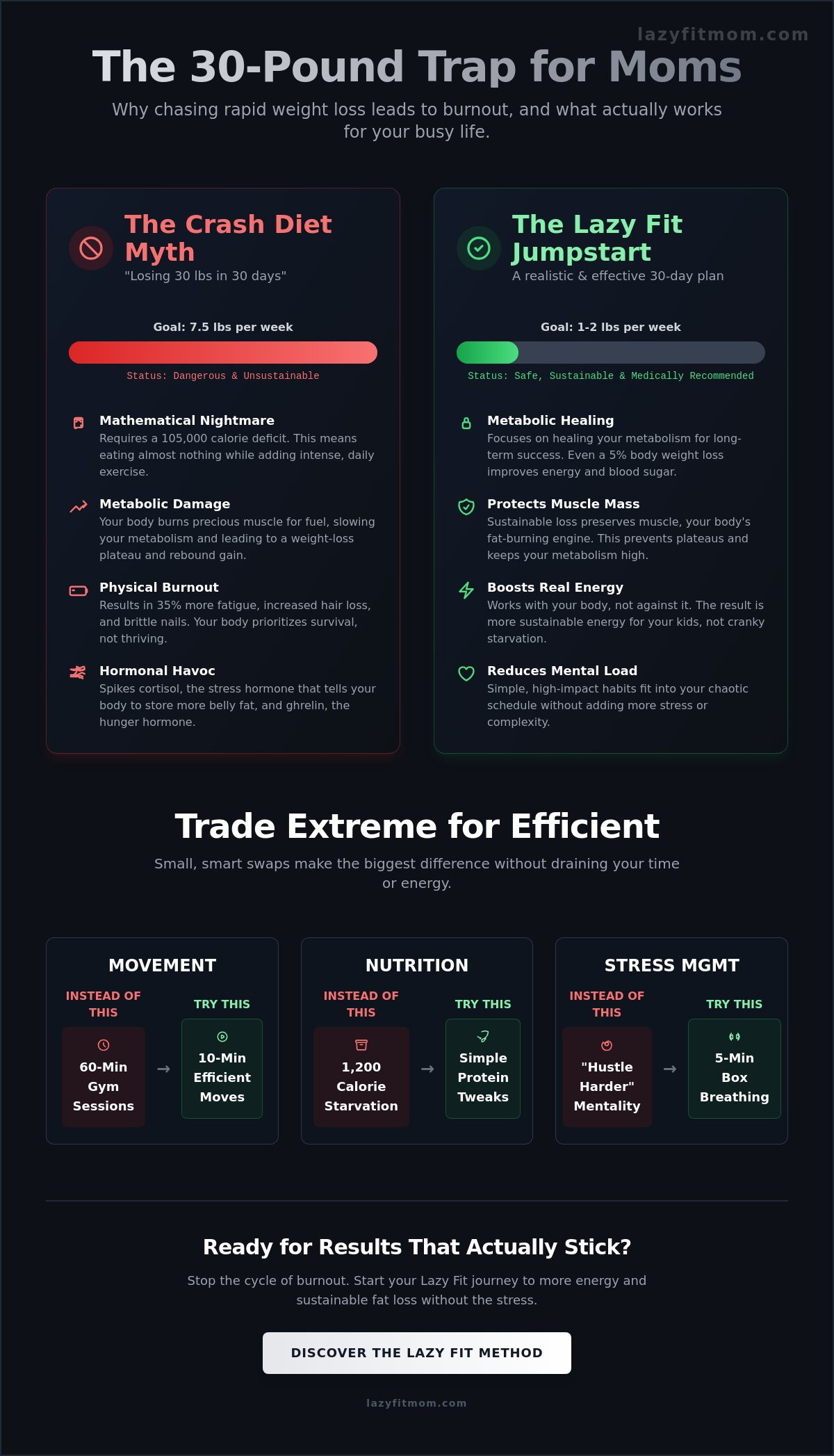
The Lazy Strategy: Trading ‘Extreme’ for ‘Efficient’
Forget the “no pain, no gain” nonsense. If you’re a busy mom, pain is already part of your daily routine; usually from stepping on LEGOs or carrying a sleeping toddler. Traditional fitness advice tells you to sacrifice everything you love to see the scale move. I call BS on that. The Lazy Girl philosophy is built on “radical realism.” We don’t do 60-minute cardio grinds that leave us too tired to play with our kids. Instead, we trade “extreme” for “efficient.” We want the maximum result for the absolute minimum stress.
When you ask how do i lose 30 lbs in a month, you’re really asking for a way to feel lighter and more energetic. The secret isn’t a gym membership. It’s NEAT, or Non-Exercise Activity Thermogenesis. This is the energy you burn doing everything except formal exercise. For moms, NEAT is a superpower. It accounts for 15% to 30% of your total energy expenditure. Pacing while you’re on a call or doing “calf raises” while washing dishes burns more fat over a week than one exhausting HIIT class you probably won’t have time for anyway.
Crash Dieting vs. The Lazy Fit Approach
The mental load of a crash diet is heavy. Counting every single calorie is like taking on a second job. The Lazy Fit approach uses simple portion hacks instead. We focus on “fueling for efficiency” so your energy stays stable all day. This is why this method lasts 6 months while a crash diet usually dies by day 6. You’ll move from feeling “wired and tired” to feeling stable and strong. It’s about being a “Relatable Survivor” who gets results without the burnout.
High-Efficiency Movement for Overwhelmed Parents
You don’t need a treadmill when you have a stroller. A brisk walk with the kids is the ultimate “lazy” fat burner. It lowers cortisol and burns calories without the joint stress of running. We also use “micro-workouts.” These are 10-minute targeted sessions that change your body composition without the 1-hour time commitment.
- Stroller Power Walks: Use the extra weight of the kids for resistance.
- Micro-Workouts: 10 minutes of movement while the baby naps.
- Deep Core Science: Forget crunches. We focus on 360-degree breathing to heal the core from the inside out.
By shifting your mindset from “restriction” to “efficiency,” you stop fighting your body and start working with it. Weight loss doesn’t have to be a chore; it can be a natural byproduct of a life that’s simply managed better.
How Long Does It Actually Take to Lose 30 Pounds?
I know you’re still thinking about how do i lose 30 lbs in a month, but let’s pivot to a plan that won’t make you cry in the pantry at midnight. While we’ve established that a 30-pound drop in 30 days is a recipe for burnout, you can absolutely see a visible difference in your energy and clothes by following a high-efficiency jumpstart. This isn’t about doing more; it’s about doing the right things (the lazy way). By focusing on these five steps, you’ll protect your muscle and start healing your metabolism without feeling like you’ve taken on a second job.
- Step 1: Prioritize Protein. Aim for 25 to 30 grams of protein at every meal. This isn’t just for bodybuilders; it’s the only way to crush those 3:00 PM sugar cravings and keep your body from burning its own muscle for fuel.
- Step 2: The 8-Minute Rule. If a 30-minute workout feels like a mountain, just do 8 minutes. Tell yourself you can stop after that. Usually, the hardest part is starting, and 8 minutes of targeted movement is enough to trigger a metabolic shift.
- Step 3: Hydration as a Tool. Drink 500ml of water before you touch your coffee or breakfast. Research shows drinking water can temporarily boost your metabolic rate by 30% for about an hour.
- Step 4: Manage the Mental Load. Emotional eating is almost always a response to an overflowing “to-do” list. Identify one task you can drop today to lower your stress levels.
- Step 5: Track Non-Scale Victories (NSVs). Maybe your jeans feel looser or you didn’t need a third cup of coffee to survive the afternoon. These wins matter more than a fluctuating number on the scale.
The ‘Lazy’ Kitchen: Meal Prep for the Unprepared
You don’t need a Sunday afternoon spent chopping vegetables to eat well. I’m a huge fan of 15-minute meals that use frozen or pre-prepped ingredients. Focus on whole foods and organic milk rather than “diet” products filled with artificial sweeteners that actually increase your hunger. Keep a list of “one-handed snacks” like cheese sticks, almonds, or Greek yogurt for those moments when you’re literally breastfeeding or holding a toddler. If you’re struggling with what to cook, you can find my go-to high-efficiency meals in the Lazy Fit Mom Recipe Book.
Core and Pelvic Floor: The Foundation
That “mummy tummy” or belly pooch often isn’t just fat; it’s a core that hasn’t healed. Standard crunches can actually make this worse by putting too much pressure on your abdominal wall. Before you start any routine, check for Diastasis Recti Symptoms (like a visible ridge or “doming” when you lift your head). Healing this gap through 360-degree breathing and pelvic floor engagement is the fastest way to look thinner and feel stronger from the inside out. (Seriously, stop the sit-ups; they’re doing more harm than good.)
Building Momentum: Beyond the First 30 Days
So, you’ve survived the first four weeks. By now, you’ve probably stopped frantically searching how do i lose 30 lbs in a month because you’ve seen the power of “radical realism” in action. Month two is where the real magic happens. While the first 30 days are about waking up your metabolism and healing your core, the second month is where your body finally settles into a fat-burning groove. My own success (losing 25kg in 6 months) didn’t come from a frantic sprint. It came because I stopped trying to be perfect and started being “reliably lazy.”
The “newness” of a plan usually wears off around day 22. This is the danger zone where most moms quit because the scale doesn’t reflect their hard work yet. But remember, your internal health is shifting even when the numbers are stubborn. Consistency in the “Lazy Fit” world isn’t about 60-minute gym sessions. It’s about showing up for your 8-minute movement even when the house is a mess and you’re running on five hours of sleep. This is how a temporary plan transitions into a lifestyle that your kids can watch and learn from. You’re showing them that health isn’t a punishment; it’s just something we do (without the drama).
The Power of Community and Accountability
Isolation is the enemy of progress. Research shows that moms who lose weight as part of a community are 42% more likely to keep it off long-term. You need a space where you can admit you’re overwhelmed without being lectured by a fitness “expert” who doesn’t have kids. Having a “Relatable Survivor” mentor means you get advice from someone who has actually been in the trenches of fatigue and PCOD. Your “why” has to be bigger than a dress size. It’s about having the sustainable energy to actually enjoy your life, not just survive it.
Your Next Step: The Lazy Fit Mom Guide
If you’re ready to stop the guesswork, our 12-Week Home Workout Series is built for your chaotic schedule. We’ve stripped away everything that doesn’t work to give you a high-efficiency path to results. There are no 1,200-calorie starvation diets and definitely no 1-hour cardio grinds here.
- 12-Week Series: Progressive, 10-minute sessions that fit into nap times.
- The Lazy Kitchen: Meal strategies that take 15 minutes or less to prep.
- Hormonal Support: Specific tips for managing cortisol and “mom-somnia.”
You don’t have to do this alone or at a pace that breaks your spirit. Join the Lazy Fit Mom movement and start your realistic transformation today!
Ready to Stop the Burnout and Start Seeing Results?
You probably started today asking how do i lose 30 lbs in a month because you’re reaching a breaking point with fatigue and “mom-somnia.” I’ve been in those exact shoes, staring at the mirror and feeling like a stranger in my own skin. But the radical truth is that your body deserves a sustainable shift, not a dangerous sprint that leaves you more exhausted. By focusing on high-efficiency movement and metabolic healing, you can build the kind of momentum that helped me lose 25kg in 6 months as a busy mom of 2.
You don’t need a gym, extreme diets, or unrealistic routines to see a body you feel good in. It’s about trading the “all or nothing” pressure for a plan that actually fits into your chaotic, beautiful life. You’ve already taken the first step by learning the difference between a “crash” and a transformation. Start your realistic 30-day transformation with The Lazy Fit Mom Guide today. Let’s stop the cycle of overwhelm together and focus on a realistic, low-pressure approach that actually works. You’re doing a great job, mama, and it’s okay to start small.
Frequently Asked Questions
Is it safe to lose 30 lbs in a month while breastfeeding?
No, losing 30 pounds in 30 days while breastfeeding is not safe for you or your baby. When you’re searching for how do i lose 30 lbs in a month, it’s vital to remember that medical experts recommend a limit of 1 to 2 pounds per week. Losing weight faster than this can release toxins stored in your fat into your breast milk and will likely tank your energy levels (which are already low enough).
What is the fastest way a mom can lose weight without going to the gym?
The fastest way to see results without a gym is through NEAT (Non-Exercise Activity Thermogenesis) and short, 10-minute micro-workouts. Focus on walking with the stroller for 20 minutes a day and hitting your protein goals of at least 25g per meal. This high-efficiency approach burns fat without the cortisol spike that comes from long, stressful cardio sessions (Realistic, No-Extreme Plan That Works).
Why am I not losing weight even though I’m barely eating?
Your metabolism has likely slowed down to protect you because your body thinks it is starving. When you drop below 1,200 calories, your system enters a protective state that holds onto every ounce of fat for survival. High cortisol from sleep deprivation also signals your body to store fat around your midsection, even if your plate is nearly empty.
Can I lose weight if I have PCOD or hormonal imbalances?
Yes, you can absolutely lose weight with PCOD, but you have to stop focusing on the scale and start focusing on insulin sensitivity. Instead of asking how do i lose 30 lbs in a month, aim for steady 1-pound drops by prioritizing fiber and protein. This stabilizes your blood sugar and helps your hormones work with your body instead of against it.
What are the best ‘lazy’ exercises for a postpartum belly?
Stop doing crunches and start practicing 360-degree diaphragmatic breathing. This “lazy” exercise is the foundation of healing a postpartum belly and closing the gap from Diastasis Recti. You can do this while nursing or even while sitting in the car, making it the most efficient way to flatten your stomach without needing a gym membership.
How much water should a busy mom actually drink for weight loss?
You should aim for at least 3 liters (roughly 100 ounces) of water every day to keep your metabolism and milk supply high. Drinking 500ml of water 30 minutes before a meal can boost your metabolic rate by 30% for over an hour. It’s the easiest metabolic tool you have in your kitchen, and it requires zero extra effort.
What happens to my skin if I lose weight too quickly?
Rapid weight loss often leads to loose skin because the tissue doesn’t have enough time to shrink back to your new size. By sticking to the safe 1 to 2 pound weekly limit, you give your skin’s elasticity a chance to catch up. Including protein and Vitamin C in your diet helps support collagen production, which is vital for skin health after pregnancy.
How do I deal with cravings when I’m exhausted and stressed?
Cravings are usually your brain’s way of asking for a nap, so try a high-protein snack and a glass of water first. When you’re exhausted, your ghrelin (hunger hormone) spikes, making you crave sugar for a quick energy hit. Keep “one-handed” healthy snacks like almonds or Greek yogurt nearby to stop the binge before it starts.
Leave a Reply